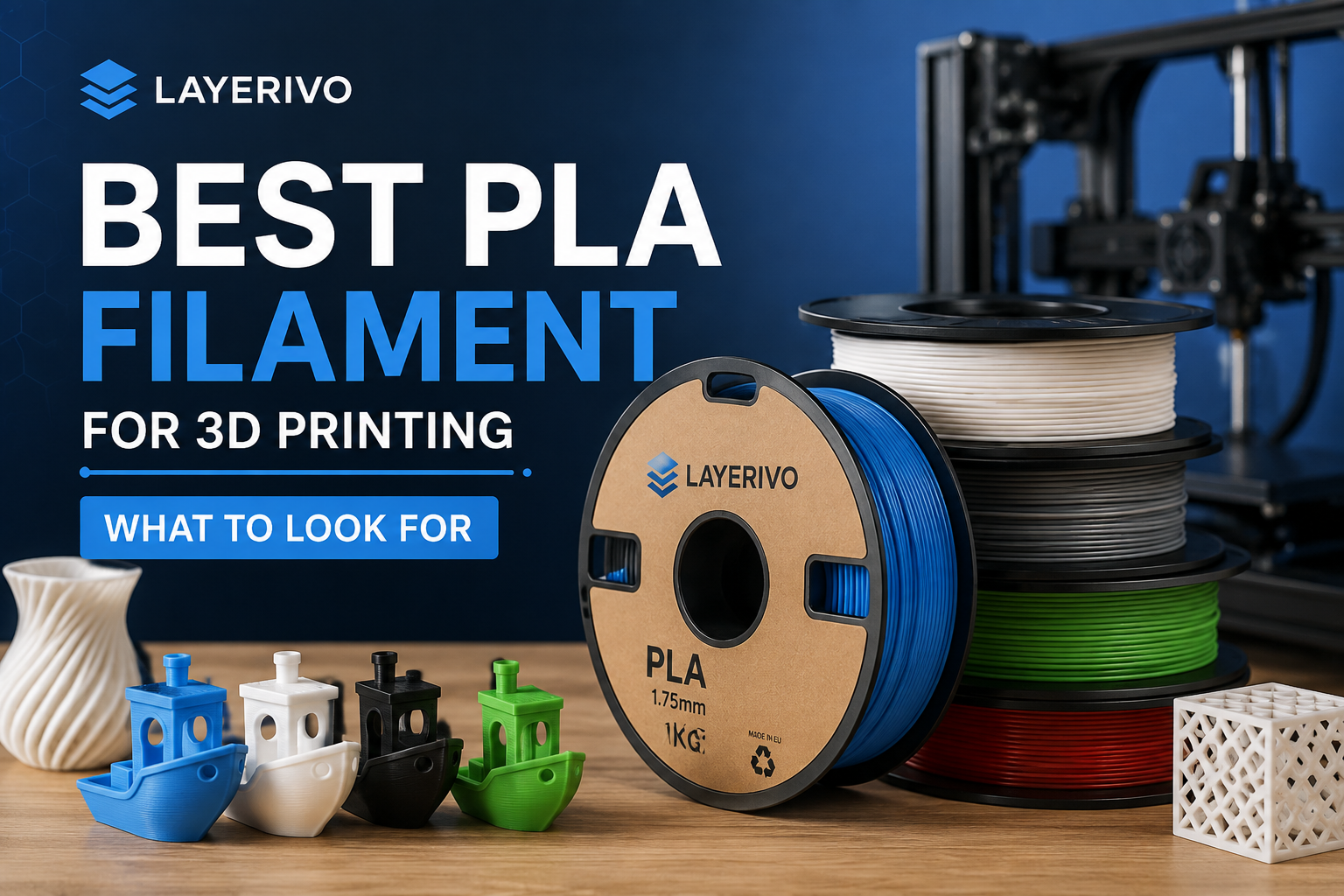
Choosing the best PLA filament can make a big difference in the quality, reliability, and appearance of your 3D prints. Although PLA is one of the easiest materials to print, different brands and types of PLA can behave very differently.
The right PLA filament should provide consistent extrusion, good layer adhesion, accurate colors, and reliable printing performance. In this guide, we will explain the most important things to look for when choosing PLA filament and how to find the best option for your 3D printer and projects.
What Makes a Good PLA Filament?
Not all PLA filaments are made exactly the same. The quality of the raw material, manufacturing process, diameter consistency, and additives can all affect how a filament prints and how the finished model looks.
Choosing the best PLA filament can help you achieve more consistent results and reduce common printing problems.
Key Features to Look For
Consistent filament diameter
Reliable extrusion
Good layer adhesion
Low moisture content
Accurate and consistent color
Smooth surface finish
Good dimensional accuracy
Consistent printing performance
1. Filament Diameter Consistency
Diameter consistency is one of the most important signs of a good PLA filament. Most desktop 3D printers use 1.75 mm filament, and significant variations in diameter can affect how much material flows through the nozzle.
A filament with consistent diameter helps maintain stable extrusion and more predictable print quality. Poorly manufactured filament may vary in thickness, which can contribute to uneven extrusion, inconsistent layers, and dimensional problems.
What to Look For
Consistent 1.75 mm diameter
Small dimensional tolerance
Uniform thickness throughout the spool
No visible bulges or unusually thin sections
Clear diameter tolerance information from the manufacturer
2. Print Temperature and Ease of Printing
Good PLA filament should have a reasonably forgiving printing temperature range. Filament that prints consistently across a practical temperature range is usually easier to tune and more reliable for different 3D printers.
Always check the temperature recommendations provided by the filament manufacturer. For additional information about PLA printing temperatures and material properties, see the official Prusa Filament Material Guide.The ideal temperature can vary depending on the printer, nozzle, print speed, layer height, and the specific PLA formulation.
Typical PLA Printing Temperature
Many PLA filaments are commonly printed at around 190°C to 220°C, but the correct temperature depends on the specific product. A temperature tower can help you find the best setting for your filament and printer.
3. Moisture and Filament Storage
PLA can absorb moisture from the surrounding air, and wet filament can cause a variety of printing problems. You may notice popping sounds from the nozzle, stringing, rough surfaces, inconsistent extrusion, or weaker prints.
Even high-quality PLA can produce poor results if it has absorbed too much moisture. For the best results, store your filament in a dry environment and keep the spool protected from humidity when it is not being used.
How to Store PLA Filament
Store the spool in an airtight bag or container
Use silica gel or another suitable desiccant
Keep the filament away from high humidity
Avoid leaving the spool exposed for long periods
Dry the filament if it shows signs of moisture
Proper storage can help maintain consistent printing performance and extend the useful life of your PLA filament.
4. PLA Color and Finish
PLA filament is available in a huge variety of colors and finishes, so appearance can be an important factor when choosing a spool. The right finish depends on the type of model you are printing and the look you want to achieve.
Standard PLA usually produces a smooth and consistent surface, while specialty PLA can offer finishes such as silk, matte, metallic, or translucent effects. These specialty materials can make decorative models more visually interesting, although they may print differently from standard PLA.
Popular PLA Finishes
Standard PLA: Smooth and versatile
Matte PLA: Low-gloss appearance and hides layer lines
Silk PLA: Shiny and reflective finish
Metallic PLA: Metal-like visual appearance
Translucent PLA: Allows some light to pass through
5. PLA Strength and Durability
PLA can produce strong and rigid 3D printed parts, which is one reason it is so popular for prototypes, models, and everyday projects. However, its performance depends heavily on print settings, part design, and the specific PLA formulation.
Compared with tougher materials such as PETG and ABS, PLA is generally more brittle and can crack under sudden impact. For parts that need to withstand repeated impacts, high temperatures, or significant mechanical stress, another material may be more appropriate.
How to Get Stronger PLA Prints
Use good layer adhesion and appropriate printing temperatures
Increase wall thickness when necessary
Use a suitable infill percentage
Choose the right print orientation
Avoid excessive printing speeds
Keep the filament dry
A high-quality PLA filament combined with well-tuned printing settings can produce surprisingly strong and reliable parts for many everyday applications.
6. PLA vs PLA+: What Is the Difference?
PLA+ is a modified version of standard PLA that is designed to improve certain properties of the material. However, PLA+ is not a standardized material, so its exact characteristics can vary significantly between manufacturers.
Some PLA+ formulations are designed to offer better toughness, impact resistance, or layer adhesion than standard PLA. The actual improvement depends on the additives and formulation used by the manufacturer.
PLA vs PLA+ Comparison
PLA: More predictable and widely standardized
PLA+: Usually designed for improved toughness or durability
PLA: Excellent for models, prototypes, and general printing
PLA+: Useful when you want more durable parts while keeping PLA’s easy printing characteristics
If you are happy with standard PLA and mainly print models or prototypes, there may be little reason to switch. PLA+ can be worth trying when you need additional toughness or durability without moving to a completely different filament.
7. Choosing PLA for Different 3D Printing Projects
The best PLA filament also depends on what you plan to print. A filament that works well for detailed decorative models may not be the best choice for functional parts or large prints.
PLA for Models and Decorative Prints
For models, figurines, and decorative objects, look for PLA that produces clean surfaces, sharp details, and consistent colors. Standard PLA, matte PLA, and silk PLA can all work well depending on the desired appearance.
PLA for Prototypes
For prototypes, consistency and reliability are often more important than specialty finishes. A good-quality standard PLA with predictable extrusion can make it easier to test different designs and make repeated changes.
PLA for Functional Parts
PLA can be suitable for many light-duty functional parts, especially when the part does not need to withstand high temperatures or heavy impacts. For more demanding applications, consider whether PETG, ABS, or another engineering filament would be more appropriate.
8. How to Choose the Best PLA Brand
When choosing the best PLA filament, price alone does not always indicate quality. There are many PLA filament brands available, so it is important to look at consistency, specifications, and user reviews. Instead of choosing a spool based only on its cost, look for manufacturers that provide clear specifications and consistent product information.
What to Check Before Buying
Filament diameter tolerance
Recommended printing temperature
Recommended bed temperature
Spool weight
Color consistency
Manufacturer specifications
User reviews and print results
A reliable manufacturer should provide enough information to help you choose suitable printing settings. Reviews from other users can also be useful for identifying problems such as inconsistent diameter, excessive moisture, or poor winding.
9. How Much Does PLA Filament Cost?
The best PLA filament does not necessarily have to be expensive. PLA is generally one of the more affordable 3D printing filaments, but prices can vary depending on the brand, spool size, color, finish, and formulation. but prices can vary depending on the brand, spool size, color, finish, and formulation. Standard PLA is usually less expensive than specialty materials such as silk, matte, metallic, or reinforced PLA.
When comparing prices, consider the amount of filament you receive and the consistency of the product rather than choosing the cheapest spool available. A slightly more expensive filament can be a better value if it provides reliable extrusion and fewer failed prints.
Is Cheap PLA Worth Buying?
Cheap PLA can still produce excellent results, especially for simple models and prototypes. However, very low-cost filament may sometimes have inconsistent diameter, poor winding, or higher moisture content, so checking reviews and manufacturer specifications is important.
10. Best PLA Filament for Beginners
For beginners, the best PLA filament is usually one that is easy to print, consistent, and forgiving while you are still learning how to tune your 3D printer. consistent, and forgiving when you are still learning how to tune your 3D printer. You do not necessarily need the most expensive filament to get good results.
If you are still choosing your first filament, see our guide to the best 3D printer filament for beginners.
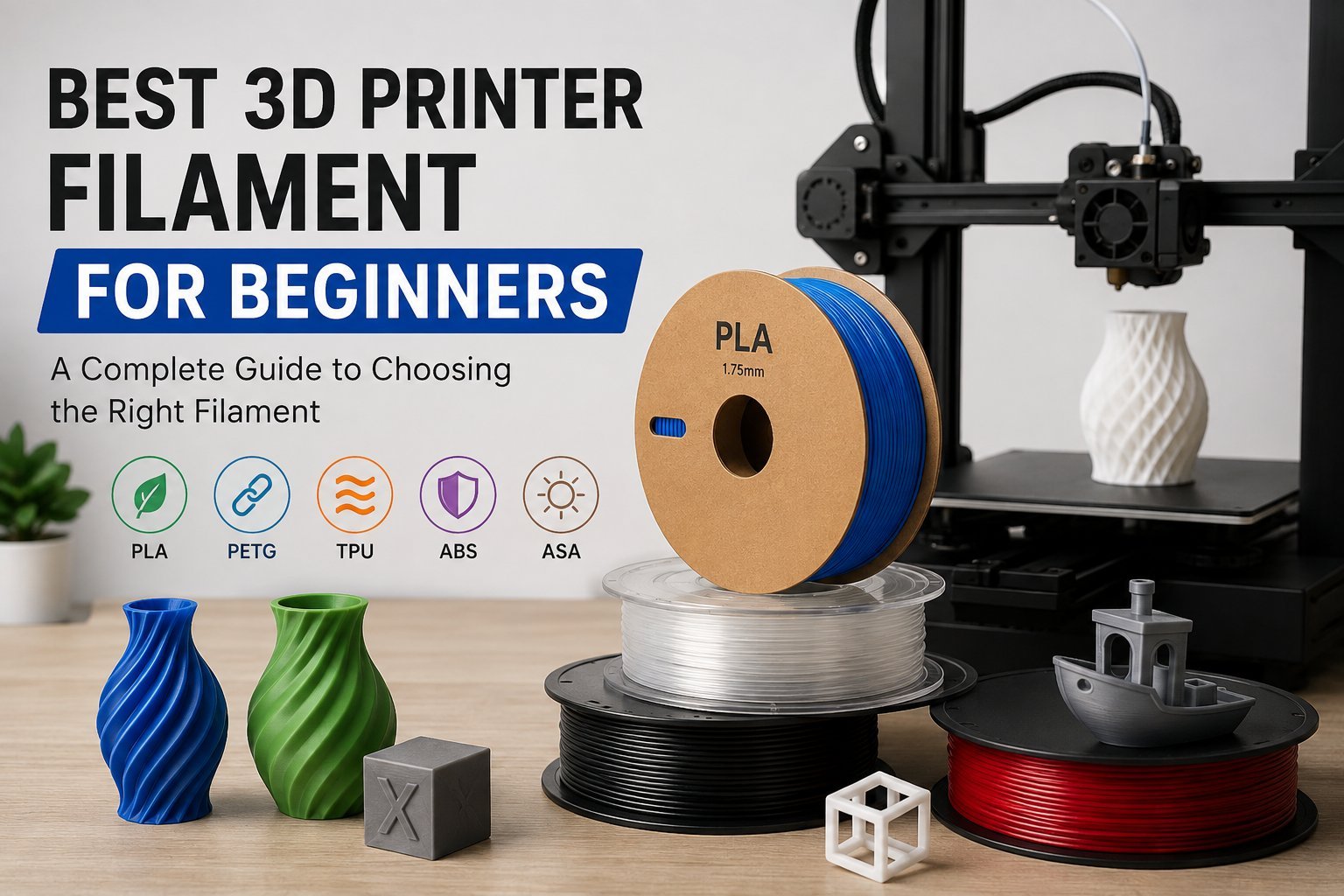
A good beginner PLA should have consistent diameter, clear temperature recommendations, reliable winding, and a good track record from other users. Standard PLA is usually the best starting point because it is simple to print and works well for a wide range of projects.
What Beginners Should Prioritize
Easy and consistent printing
Reliable filament diameter
Good bed adhesion
Low tendency to warp
Clear manufacturer recommendations
Good value for money
A wide range of available colors
Once you become comfortable with standard PLA, you can experiment with specialty PLA such as matte, silk, metallic, or PLA+ to achieve different appearances and performance characteristics.
11. Common PLA Printing Problem
Even good-quality PLA can produce poor results if the printer settings, storage conditions, or bed preparation are not correct. Understanding common problems can help you determine whether the issue is the filament or the printer settings.
Stringing
Stringing occurs when thin strands of filament appear between separate parts of a print. It can often be reduced by adjusting retraction settings, printing temperature, travel speed, and filament dryness.
Poor Bed Adhesion
If the first layer does not stick properly to the build plate, check the bed level, build plate cleanliness, nozzle height, and first-layer temperature. Moisture or incorrect printing settings can also contribute to adhesion problems.
Inconsistent Extrusion
Inconsistent extrusion can result in gaps, weak layers, or uneven surfaces. Possible causes include wet filament, an incorrect printing temperature, a partially clogged nozzle, or inconsistent filament diameter.
How to Get the Best Results from PLA
Getting the best results from PLA is not only about choosing a good filament. Proper storage, suitable printing temperatures, a clean build plate, and well-tuned printer settings all play an important role in print quality.
A reliable best PLA filament can make it easier to achieve consistent results across different projects.
PLA Printing Checklist
Keep the filament dry
Use the manufacturer’s recommended temperature range
Make sure the build plate is clean and properly leveled
Use appropriate retraction settings
Choose a suitable print speed
Check the first layer before starting a long print
Store the spool in a dry environment
If you consistently use good-quality filament and keep your printer properly calibrated, PLA can produce reliable results with excellent detail and surface quality.
Frequently Asked Questions
What is the best PLA filament for beginners?
The best PLA filament for beginners is usually one that offers consistent diameter, reliable extrusion, easy printing, and clear temperature recommendations. Standard PLA from a reliable manufacturer is a good place to start.
What temperature should PLA be printed at?
Many PLA filaments are commonly printed between 190°C and 220°C, but the ideal temperature depends on the specific filament, printer, nozzle, print speed, and other settings. Always follow the manufacturer’s recommendations and test the filament if necessary.
Is PLA+ better than regular PLA?
PLA+ is designed by some manufacturers to provide improved toughness or durability compared with standard PLA. However, PLA+ is not a standardized material, so its performance can vary between brands.
How should PLA filament be stored?
PLA should be stored in a dry environment, preferably in an airtight container or bag with a suitable desiccant. Keeping the spool protected from humidity helps maintain consistent printing performance.
How long does PLA filament last?
PLA filament can remain usable for a long time when it is stored properly and kept away from moisture. Poor storage conditions can cause the filament to absorb moisture and may reduce print quality over time.
Leave a Reply