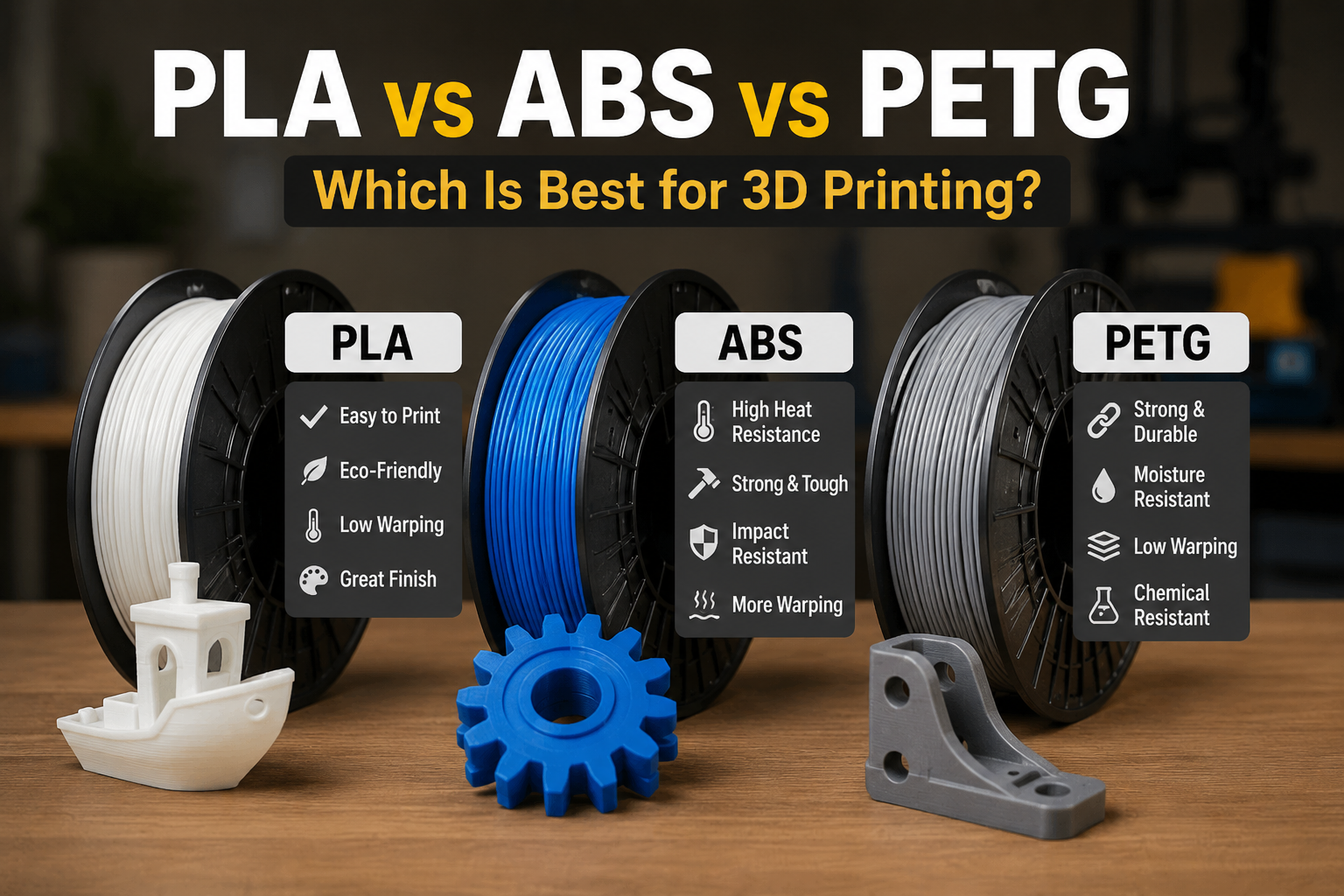
Choosing the right filament is one of the most important decisions in 3D printing. PLA, ABS, and PETG are three of the most popular materials, but each one has different strengths, weaknesses, and printing requirements.
PLA is known for being easy to print and beginner-friendly, while ABS offers better heat resistance and PETG provides a balance of strength, durability, and ease of printing. Understanding these differences can help you choose the right filament for your project.
PLA vs ABS vs PETG: Quick Comparison
| Feature | PLA | ABS | PETG |
|---|---|---|---|
| Ease of printing | Excellent | Difficult | Good |
| Strength | Good | Good | Very good |
| Impact resistance | Low to moderate | High | High |
| Heat resistance | Low | High | Moderate to high |
| Warping | Very low | High | Low to moderate |
| Odor while printing | Low | Noticeable | Low |
| Enclosure needed | No | Recommended | Usually no |
| Outdoor use | Limited | Good | Good |
| Best for | Models & prototypes | Functional parts | Strong everyday parts |
For more detailed material specifications and printing requirements, see the Prusa Filament Material Guide.
What Is PLA?
PLA, or Polylactic Acid, is one of the most popular materials used in FDM 3D printing. It is known for being easy to print, widely available, and suitable for a wide range of models and everyday projects.
PLA usually prints at relatively low temperatures and has a low tendency to warp. It also produces good surface quality and fine details, making it an excellent choice for beginners and detailed prints.
Advantages of PLA
Easy to print
Low tendency to warp
Excellent surface detail
Available in many colors and finishes
Generally inexpensive
Does not usually require an enclosure
Great for prototypes and decorative models
Disadvantages of PLA
Lower heat resistance than ABS and PETG
Can become soft in high temperatures
More brittle than some other common filaments
Not ideal for demanding outdoor applications
Limited suitability for parts exposed to high heat
What Is PLA Best For?
Beginner 3D printing
Decorative models
Prototypes
Display pieces
Small household objects
Architectural models
Detailed prints
What Is ABS?
ABS, or Acrylonitrile Butadiene Styrene, is a durable thermoplastic commonly used for functional and mechanical parts. Compared with PLA, ABS offers better heat resistance and impact resistance, making it useful for more demanding applications.
However, ABS is more difficult to print than PLA. It is more prone to warping and usually benefits from careful temperature control and an enclosed printing environment.
Advantages of ABS
Good heat resistance
Good impact resistance
Durable
Suitable for functional parts
Better suited to high-temperature environments
Can be post-processed with acetone vapor
Disadvantages of ABS
More difficult to print than PLA
Higher tendency to warp
Usually benefits from an enclosed printer
Produces noticeable fumes and odor during printing
Requires more careful temperature control
What Is ABS Best For?
Functional components
Mechanical parts
Automotive components
Parts exposed to higher temperatures
Durable enclosures
Applications where impact resistance matters
What Is PETG?
PETG, or Polyethylene Terephthalate Glycol-modified, is a popular 3D printing filament that offers a useful balance between strength, durability, and ease of printing. It is often considered a middle ground between PLA and ABS.
Advantages of PETG
Good strength
Excellent layer adhesion
Good impact resistance
Better heat resistance than PLA
Lower warping than ABS
Suitable for functional parts
Can be used for many outdoor applications
Disadvantages of PETG
Can be more difficult to print than PLA
Can produce stringing
Surface can be more difficult to finish
Can be sensitive to incorrect printing temperatures
Often has a more glossy appearance than PLA
What Is PETG Best For?
Functional parts
Mechanical components
Brackets and mounts
Containers
Protective covers
Outdoor parts
Parts that need a combination of strength and durability
PLA vs ABS vs PETG: Strength
Strength is one of the most important factors when comparing PLA vs ABS vs PETG. PLA can produce strong and rigid parts, but it is generally more brittle than ABS and PETG when subjected to sudden impacts.
ABS offers good impact resistance and is commonly used for parts that need to withstand physical stress. PETG also provides very good toughness and layer adhesion, making it a strong option for functional parts.
Which Is Strongest?
PLA: Strong and rigid, but more brittle
ABS: Tough and impact-resistant
PETG: Strong, tough, and excellent layer adhesion
For many everyday functional parts, PETG offers a very useful balance of strength and toughness.
PLA vs ABS vs PETG: Heat Resistance
Heat resistance is another important factor when comparing PLA vs ABS vs PETG.PLA has the lowest heat resistance of the three and can soften when exposed to relatively high temperatures.
Heat Resistance Comparison
ABS: Best heat resistance
PETG: Moderate to high heat resistance
PLA: Lowest heat resistance
If heat resistance is a major requirement, ABS is usually the strongest choice, while PETG provides a good balance between heat resistance and ease of printing.
PLA vs ABS vs PETG: Ease of Printing
When comparing PLA vs ABS vs PETG, ease of printing can be just as important as strength or heat resistance. PLA is the easiest of these three materials to print and usually requires the least amount of tuning.
PETG is also relatively beginner-friendly, although it can require more tuning because of issues such as stringing. ABS is generally the most demanding option because it is more prone to warping and requires better temperature control.
Ease of Printing Comparison
PLA: Easiest to print
PETG: Moderately easy to print
ABS: Most difficult to print
If you are using your first 3D printer, PLA is usually the safest material to start with before moving on to PETG or ABS.
PLA vs ABS vs PETG: Warping
Warping happens when different parts of a printed object cool and contract unevenly. It can cause the corners of a print to lift from the build plate and can lead to failed or distorted prints.
PLA has relatively low shrinkage, which makes it easier to print. PETG generally has less warping than ABS, although good bed adhesion and temperature settings are still important.
Warping Comparison
PLA: Very low
PETG: Low to moderate
ABS: High
Which Filament Is Best for Beginners?
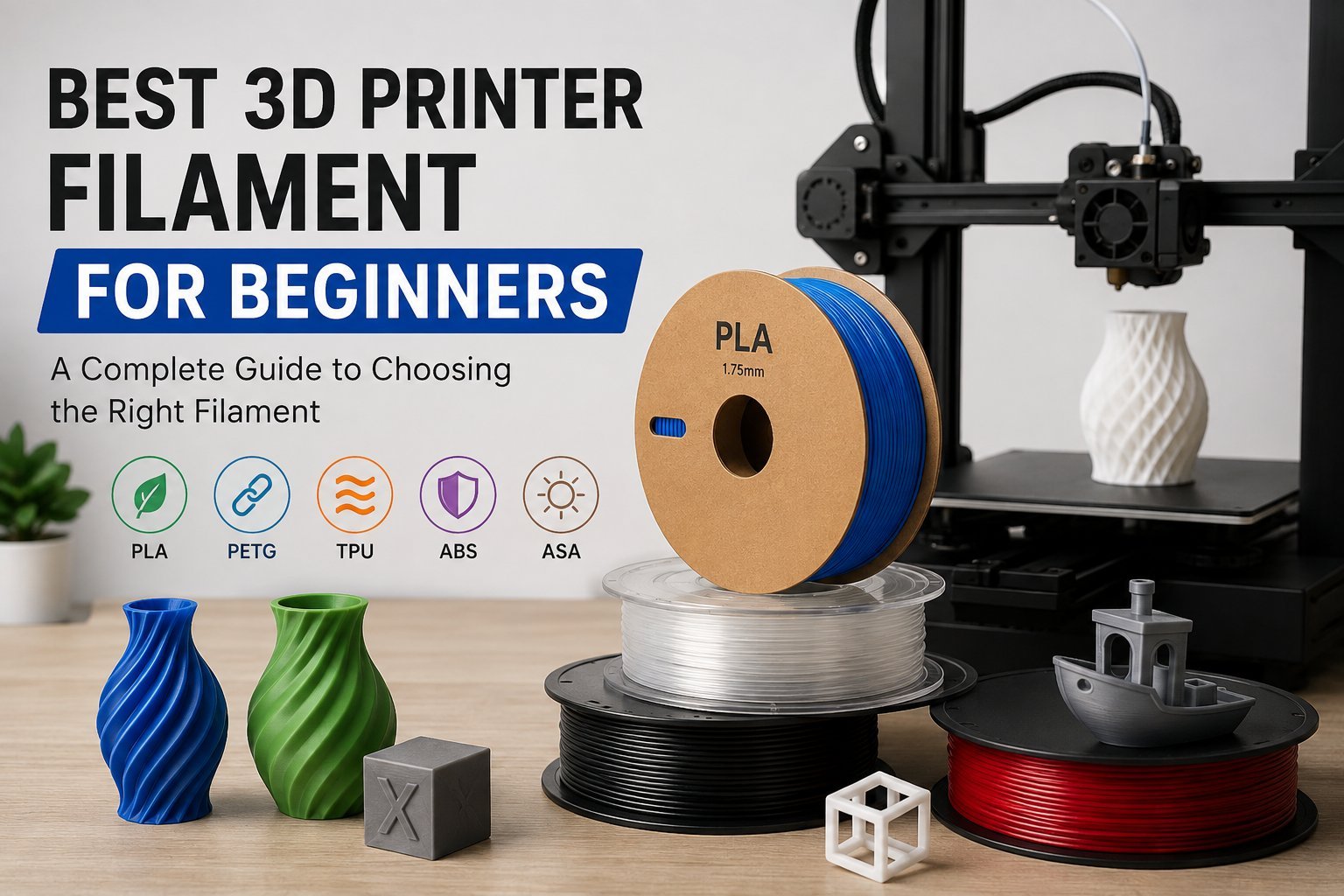
When comparing PLA vs ABS vs PETG, PLA is the best choice for most beginners. It is easy to print, widely available, relatively affordable, and works well for a wide range of projects.
If you are choosing your first filament, see our guide to the best 3D printer filament for beginners.
PETG is a good next step if you need stronger and more durable parts. ABS is better suited to users who need higher heat resistance and impact resistance and are comfortable with more demanding printing requirements. For a deeper comparison of high-temperature materials, see our guide to the best heat-resistant 3D printer filament.
Choose PLA If
You are new to 3D printing
You want easy and reliable printing
You are making models or prototypes
You want good surface detail
You do not need high heat resistance
Choose PETG If
You need stronger functional parts
You want good impact resistance
You need better heat resistance than PLA
You want a versatile everyday filament
Choose ABS If
You need higher heat resistance
You need good impact resistance
You are printing demanding functional parts
Your printer has an enclosure
You are comfortable tuning printing settings
Which Filament Is Best for Functional Parts?
When comparing PLA vs ABS vs PETG for functional parts, PETG and ABS are generally more suitable than PLA. The right choice depends on how much heat, impact, and mechanical stress the part will experience.
PETG Is a Good Choice for
Functional brackets and mounts
Mechanical components
Protective covers
Containers
Everyday household parts
Parts that need good impact resistance
ABS Is a Good Choice for
Parts exposed to higher temperatures
Durable mechanical components
Automotive parts
Impact-resistant enclosures
Applications requiring greater heat resistance
Which Filament Is Best for Outdoor Use?
Outdoor 3D printed parts can be exposed to sunlight, heat, moisture, and changing temperatures. Because of these conditions, choosing the best filament for outdoor 3D printing is important if you want the part to remain stable and functional over time.
Outdoor Filament Comparison
PLA: Limited for long-term outdoor use
PETG: Good option for many outdoor applications
ABS: Good heat resistance and suitable for demanding outdoor parts
For demanding outdoor applications, always consider the specific filament formulation and the environmental conditions the printed part will experience.
Final Verdict: PLA vs ABS vs PETG
There is no single filament that is best for every 3D printing project. PLA, ABS, and PETG each have different advantages, so the right choice depends on your printer, your experience level, and how the finished part will be used.
PLA is the best overall choice for most beginners because it is easy to print, affordable, and produces excellent-looking results. PETG is an excellent option when you need stronger and more durable parts, while ABS is better suited to demanding applications where heat resistance and impact resistance are important.
Quick Recommendation
PLA: Best for beginners, models, prototypes, and easy printing
PETG: Best for strong, durable, and versatile functional parts
ABS: Best for high-heat and impact-resistant applications
For most new 3D printer owners, a good approach is to start with PLA and move to PETG or ABS when your projects require their specific advantages.
Frequently Asked Questions
Is PLA better than ABS and PETG for beginners?
Yes. PLA is generally the easiest of the three materials to print and is a great choice for beginners. It requires less temperature control and has a lower tendency to warp than ABS or PETG.
Is PETG stronger than PLA?
PETG is generally tougher and more impact-resistant than PLA. However, the strength of a printed part also depends on factors such as print orientation, layer height, infill, and printing settings.
Is ABS stronger than PETG?
ABS and PETG have different strengths. ABS offers good impact and heat resistance, while PETG provides excellent layer adhesion and toughness. The better choice depends on the specific application.
Which filament is best for high temperatures?
The best filament for high-temperature applications depends on the required operating temperature, mechanical load, and printing conditions. ABS can work well for moderate heat, while Nylon and polycarbonate (PC) are better options for more demanding applications. Specialized materials such as PEEK and PEKK are used when even higher performance is required.
Can you use PLA, ABS, and PETG on the same 3D printer?
Many FDM 3D printers can print PLA, PETG, and ABS, but the printer requirements and recommended settings are different for each material. ABS may require an enclosed printer, while PLA and PETG are generally easier to print on open-frame machines.
Leave a Reply