
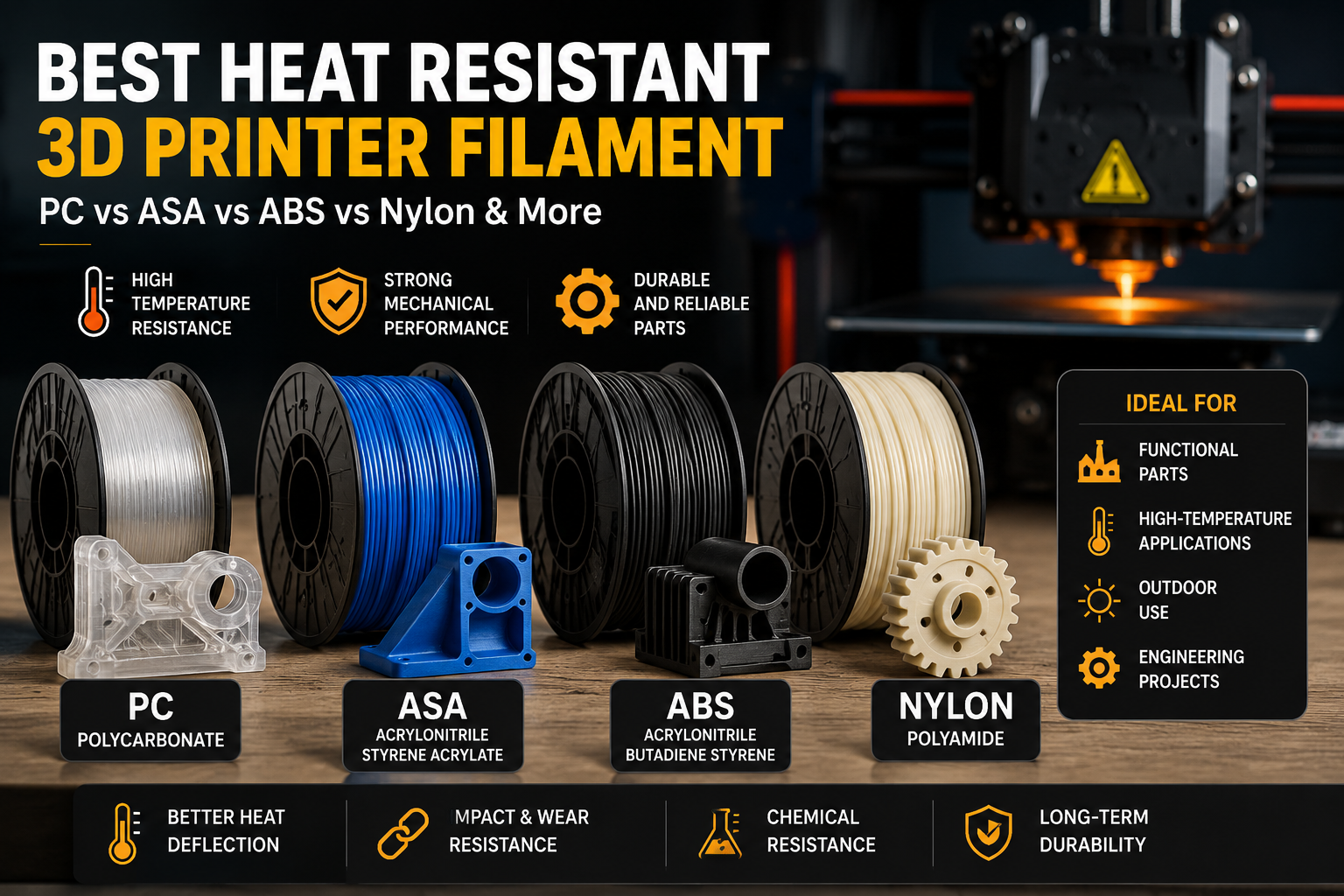
Choosing the best heat resistant 3D printer filament is important when a printed part will be exposed to high temperatures, hot air, direct heat, or demanding mechanical conditions. A material that works perfectly for an indoor decorative model may soften or deform when used near a heat source.
PLA is easy to print but has relatively low heat resistance. Materials such as ABS and ASA can handle higher temperatures, while polycarbonate (PC) and some engineering filaments can provide substantially higher thermal performance when printed under the right conditions.
In this guide, we will compare the best heat-resistant 3D printer filaments, including PC, ASA, ABS, Nylon, and other high-temperature materials. We will explain heat resistance, printing difficulty, typical applications, and how to choose the right filament for your specific project.
What Makes a 3D Printer Filament Heat Resistant?
Heat resistance is not determined by a single temperature number. A filament can begin to soften, deform under load, or lose mechanical performance at different temperatures depending on the material, formulation, print settings, and test method used.
Heat Deflection Temperature (HDT)
Heat Deflection Temperature, or HDT, indicates the temperature at which a material deforms under a specified load during a standardized test. It is useful when comparing materials, but it should not be treated as the maximum temperature at which every printed part can safely operate.
Glass Transition Temperature (Tg)
The glass transition temperature describes a change in the behavior of a polymer as it becomes softer and more flexible. It can help explain why some materials lose rigidity as temperatures increase, but Tg alone does not determine the real-world temperature limit of a finished 3D printed part.
Continuous Heat Exposure
A part exposed to heat for hours or days may behave differently from a part that briefly reaches the same temperature. For applications involving continuous heat, consider the expected operating temperature, mechanical load, exposure time, and the manufacturer’s published material data.
Why the Printed Part Matters
The heat resistance of the filament itself is only part of the equation. Layer adhesion, print orientation, wall thickness, infill, cooling, and annealing can all affect how a finished 3D printed component performs at elevated temperatures.
For this reason, a filament advertised as heat resistant should not automatically be considered suitable for every high-temperature application. Always compare the material’s published data with the actual conditions your part will experience.
For a broader comparison of filament properties, temperatures, and printer requirements, see the Prusa Research Filament Material Guide.
Best Heat-Resistant 3D Printer Filaments Compared
The best heat-resistant filament depends on the temperature, mechanical load, and printing environment required by your application. PC, ASA, ABS, and Nylon can all handle more heat than standard PLA, but they differ significantly in printability, strength, moisture sensitivity, and temperature performance.
For many functional applications, the best heat resistant 3D printer filament depends on both the required temperature performance and how difficult the material is to print.
1. Polycarbonate (PC)
Polycarbonate is one of the strongest choices for high-temperature FDM applications that can be handled by advanced desktop printers. It offers high heat resistance, good impact strength, and excellent mechanical performance when printed correctly.
High heat resistance
Excellent impact strength
High mechanical strength
Suitable for demanding functional parts
Good choice for engineering applications
The main drawback of PC is its printing difficulty. It generally requires high extrusion temperatures and a stable heated environment, and large parts can be prone to warping. Some PC blends are easier to print than pure polycarbonate.
For demanding engineering parts, the best heat resistant 3D printer filament may be polycarbonate when your printer can handle its processing requirements.
2. ASA
ASA is best known for outdoor durability and UV resistance, but it also provides better heat resistance than PLA and is suitable for many applications exposed to elevated temperatures. It can be a useful middle ground when you need both weather resistance and improved thermal performance.
Good heat resistance
Excellent UV resistance
Good mechanical durability
Suitable for outdoor and automotive applications
More accessible than many high-temperature engineering materials
ASA is easier to work with than many high-temperature engineering filaments, but it can still warp and benefits from a controlled printing environment. It is usually not the first choice when the application requires the highest possible continuous operating temperature.
When outdoor exposure and elevated temperatures are combined, the best heat resistant 3D printer filament may need to provide both thermal and UV resistance.
3. ABS
ABS has been widely used for functional 3D printed parts because it offers good toughness and higher heat resistance than PLA. It can be suitable for components exposed to moderate heat, particularly when UV resistance is not the primary requirement.
Good heat resistance
Good toughness
Suitable for functional parts
Common and widely supported material
Can be post-processed with acetone vapor
ABS can be more demanding to print than PLA or PETG because of warping and shrinkage. An enclosure and stable ambient temperature can improve reliability, especially for larger parts.
If you want a broader comparison of the most common FDM materials, see our guide to PLA vs ABS vs PETG.
For moderate high-temperature applications, the best heat resistant 3D printer filament may be ABS or ASA rather than a more difficult engineering material.
4. Nylon (PA)
Nylon can provide a strong combination of toughness, wear resistance, and heat performance. It is particularly useful for functional components that need to withstand mechanical stress as well as elevated temperatures.
High toughness
Good wear resistance
Good mechanical strength
Useful for functional components
Available in reinforced versions such as carbon-fiber-filled PA
Nylon is sensitive to moisture and generally needs careful filament storage and drying. Printing can also be more demanding than PLA or PETG, so it is better suited to users who are comfortable controlling material and printer conditions.
For mechanical parts that also face heat, the best heat resistant 3D printer filament may be a suitable Nylon or reinforced Nylon formulation.
PEEK, PEKK, and Other High-Temperature Filaments
When standard engineering filaments are not sufficient, specialized materials such as PEEK and PEKK can provide much higher temperature and mechanical performance. However, these materials belong to a very different class of 3D printing and usually require specialized equipment and carefully controlled printing conditions.
PEEK
PEEK is a high-performance thermoplastic known for exceptional heat resistance, mechanical strength, chemical resistance, and long-term stability. It is used in demanding industrial and engineering applications where conventional desktop materials cannot meet the requirements.
PEKK
PEKK is another high-performance polymer designed for demanding applications. It can provide excellent thermal and mechanical properties while offering processing characteristics that differ from PEEK.
Do You Need PEEK or PEKK?
For most hobbyist and desktop 3D printing projects, PEEK and PEKK are unnecessary. PC, ASA, ABS, and suitable Nylon or reinforced Nylon materials can cover a much wider range of practical high-temperature applications.
PEEK and PEKK should be considered only when the application’s temperature, mechanical, chemical, or long-term performance requirements justify the additional cost and specialized printing equipment.
Heat Resistance Comparison: PLA vs PETG vs ABS vs ASA vs PC vs Nylon
The table below gives a practical comparison of common FDM materials. Treat the heat-resistance categories as general guidance rather than guaranteed operating limits, because the actual performance of a printed part depends on the specific filament formulation, print settings, geometry, and mechanical load.
Comparing the best heat resistant 3D printer filament options side by side makes it easier to match each material to a specific application.
| Filament | Heat Resistance | Ease of Printing | Best For |
|---|---|---|---|
| PLA | Low | Excellent | Decorative and general indoor parts |
| PETG | Moderate | Very Good | General-purpose functional parts |
| ABS | Good | Moderate | Functional parts exposed to moderate heat |
| ASA | Good–High | Moderate | Outdoor and heat-exposed parts |
| Nylon / PA | High | More Difficult | Functional and mechanical components |
| PC | Very High | Difficult | High-temperature engineering applications |
Which Heat-Resistant Filament Is Best for Beginners?
For beginners who need better heat resistance than PLA, PETG is often the easiest step up, although its thermal performance remains limited compared with engineering materials. ABS and ASA provide higher heat resistance but require more attention to printing conditions, while PC and Nylon are better suited to users with more capable printers and greater experience.
The best heat resistant 3D printer filament should match the actual operating conditions rather than simply having the highest advertised rating.
Which Filament Is Best for High-Temperature Applications?
For demanding high-temperature applications, PC and specialized Nylon materials are strong choices among commonly available engineering filaments. For even more extreme requirements, materials such as PEEK and PEKK offer substantially higher performance but require specialized equipment and processing conditions.
How to Choose the Right Heat-Resistant Filament
The right heat-resistant filament depends on the temperature your part will experience, how long it will be exposed to heat, and whether it will carry a mechanical load. Your printer’s capabilities are equally important because some high-temperature materials require an enclosure, a heated chamber, a high-temperature hotend, or a heated build plate.
The best heat resistant 3D printer filament is not necessarily the material with the highest temperature rating; it must also suit your printer and the conditions of use.
For Moderate Heat
If your part only needs to tolerate moderate heat, PETG, ABS, or ASA may be sufficient depending on the application. These materials are considerably easier to print than advanced engineering polymers.
For High Heat
For higher-temperature applications, consider Nylon, reinforced Nylon, or polycarbonate. These materials can provide better thermal and mechanical performance, but they generally require more careful printer setup and material handling.
For Extreme Temperature Applications
Applications involving very high temperatures or demanding long-term mechanical performance may require specialized materials such as PEEK or PEKK. These materials are normally intended for advanced or industrial 3D printing systems rather than standard hobbyist printers.
Check Your Printer Before Choosing the Filament
Before buying a high-temperature filament, check your printer’s maximum nozzle temperature, maximum bed temperature, enclosure requirements, and whether the manufacturer recommends a heated chamber. A filament may have excellent thermal properties but still be unsuitable for your printer.
Check the required nozzle temperature
Check the required build plate temperature
Check whether an enclosure is recommended
Check whether a heated chamber is required
Check the filament’s drying requirements
Check the manufacturer’s recommended printing conditions
Your printer’s capabilities are therefore part of choosing the best heat resistant 3D printer filament, not just the material’s thermal properties.
Choosing a material that your printer can reliably process is just as important as choosing one with the right thermal properties. A slightly less heat-resistant material that prints correctly can be more useful than a high-performance filament that your printer cannot process properly.
How to Improve Heat Resistance of 3D Printed Parts
The filament is not the only factor that determines how well a 3D printed part performs under heat. Print settings, part geometry, orientation, and post-processing can all affect thermal performance.
Use More Perimeters
Increasing the number of perimeters can improve the structural strength of a printed part. This can be particularly useful when the part will be exposed to heat while also carrying a mechanical load.
Choose the Right Print Orientation
Print orientation affects the direction of the layers and therefore the way the finished part responds to mechanical stress. Orient the part so that important loads are distributed in a way that reduces the risk of failure between layers.
Consider Annealing
Some thermoplastics can benefit from annealing, a controlled heating process that can change the material’s internal structure and improve dimensional stability or heat performance. However, annealing can also cause shrinkage or dimensional changes, so it should be tested before being used on a critical component.
Use an Enclosure When Appropriate
An enclosure can help maintain a stable printing environment and reduce temperature differences during printing. This is especially useful for materials that are prone to warping, such as ABS, ASA, and some polycarbonate and Nylon formulations.
For demanding applications, the best approach is to combine an appropriate filament with correct printing conditions and a suitable part design. Do not rely on post-processing alone to compensate for a material that is unsuitable for the required operating temperature.
Common Mistakes When Choosing Heat-Resistant Filament
Choosing a filament based only on its advertised temperature rating can lead to disappointing results. The real performance of a printed part depends on the material, printing process, part design, and the conditions it will experience in use.
Choosing the best heat resistant 3D printer filament requires looking beyond a single temperature number.
Choosing the Highest Temperature Rating Automatically
A material with a higher published temperature rating is not automatically the best choice. If your application only involves moderate heat, a material that is easier to print may provide a more reliable and cost-effective solution.
Ignoring Mechanical Load
Heat can reduce the stiffness and strength of polymers, especially when a part is under continuous load. Consider both temperature and mechanical stress when deciding whether a filament is suitable for a functional component.
Using a Filament Your Printer Cannot Handle
High-temperature filaments often require higher nozzle and bed temperatures, and some benefit from an enclosure or heated chamber. Always check your printer’s specifications before purchasing the material.
Ignoring Moisture and Filament Storage
Some engineering filaments, particularly Nylon, can absorb significant amounts of moisture from the air. Wet filament can cause printing defects and reduce the consistency of the finished part, so proper storage and drying may be necessary.
Assuming a Printed Part Will Match the Filament Data Sheet
Material data sheets provide useful information, but a finished 3D printed part may perform differently depending on its geometry, layer orientation, print settings, and load. For critical applications, test the actual printed component under realistic conditions before relying on it.
The best heat resistant 3D printer filament for a hobbyist may be very different from the material required for an industrial application.
Best Heat-Resistant 3D Printer Filament: Quick Comparison
| Filament | Heat Resistance | Print Difficulty | Best For |
|---|---|---|---|
| PLA | Low | Easy | Indoor and low-heat parts |
| PETG | Moderate | Easy–Moderate | General functional parts |
| ABS | Good | Moderate | Functional parts with moderate heat |
| ASA | Good–High | Moderate–Difficult | Outdoor and heat-exposed parts |
| Nylon / PA | High | Difficult | Mechanical components |
| Polycarbonate (PC) | Very High | Difficult | High-temperature engineering parts |
| PEEK / PEKK | Extreme | Very Difficult | Specialized industrial applications |
Note: Temperature values should not be treated as universal limits for every filament. Heat resistance can vary significantly between brands and formulations, and different tests such as HDT, glass transition temperature (Tg), and continuous-use temperature measure different properties. For a critical application, always check the manufacturer’s technical data sheet and test the actual printed part under realistic conditions.
For most desktop 3D printing users, PC, Nylon, ASA, and ABS cover a wide range of applications that require more heat resistance than PLA. PEEK and PEKK belong to a specialized category and normally require dedicated high-temperature printing equipment.
Final Verdict: What Is the Best Heat-Resistant 3D Printer Filament?
Polycarbonate is one of the strongest choices when high heat resistance is the primary requirement and your printer is capable of processing it correctly. Nylon and reinforced Nylon are excellent alternatives when mechanical strength, toughness, and wear resistance are also important.
For more moderate heat requirements, ABS and ASA can provide a practical balance between thermal performance and accessibility. ASA is particularly attractive when the part will also be exposed to sunlight and outdoor conditions.
For extreme temperature and demanding engineering applications, specialized materials such as PEEK and PEKK can provide much higher performance, but they require specialized equipment and are unnecessary for most hobbyist projects.
Ultimately, the best heat resistant 3D printer filament depends on the temperature, mechanical load, exposure time, and capabilities of your 3D printer.
Quick Recommendation
Best for high heat: Polycarbonate (PC)
Best for heat and mechanical toughness: Nylon / PA
Best for heat and outdoor exposure: ASA
Best for moderate heat with easier printing: ABS
Best for extreme industrial applications: PEEK or PEKK
If you are still unsure which is the best heat resistant 3D printer filament for your project, start with the actual operating temperature and mechanical requirements.
Frequently Asked Questions
What is the best heat-resistant 3D printer filament?
Polycarbonate (PC) is one of the best choices for high-temperature FDM applications when the printer can handle the required printing conditions. Nylon and reinforced Nylon are also strong options for applications that require both heat resistance and mechanical performance.
Is PETG heat resistant?
PETG has better heat resistance than PLA, but it is not normally considered a high-temperature engineering filament. It can work well for applications involving moderate heat, while ABS, ASA, Nylon, or PC may be more appropriate for higher temperatures.
Is ASA more heat resistant than PLA?
Yes. ASA generally provides better heat resistance than standard PLA and is also much better suited to prolonged UV exposure. It is a useful choice when a part needs both outdoor durability and improved thermal performance.
Is ABS good for high-temperature 3D printing?
ABS provides good heat resistance compared with PLA and can be suitable for many functional parts exposed to moderate heat. For significantly higher temperatures, materials such as PC or suitable Nylon formulations may be more appropriate.
Is Nylon heat resistant?
Nylon can provide good heat resistance along with excellent toughness, wear resistance, and mechanical performance. However, Nylon is more demanding to print and can absorb moisture, so proper drying and storage are important.
Is Polycarbonate better than ABS for heat resistance?
Polycarbonate generally offers higher heat resistance than standard ABS, along with strong mechanical performance. However, PC is more difficult to print and usually requires a more capable printer and controlled printing environment.
What is the best filament for a part exposed to constant heat?
The best material depends on the actual operating temperature, mechanical load, and exposure time. For demanding continuous heat, PC or suitable Nylon may be appropriate, while extreme applications may require specialized materials such as PEEK or PEKK.
Leave a Reply