
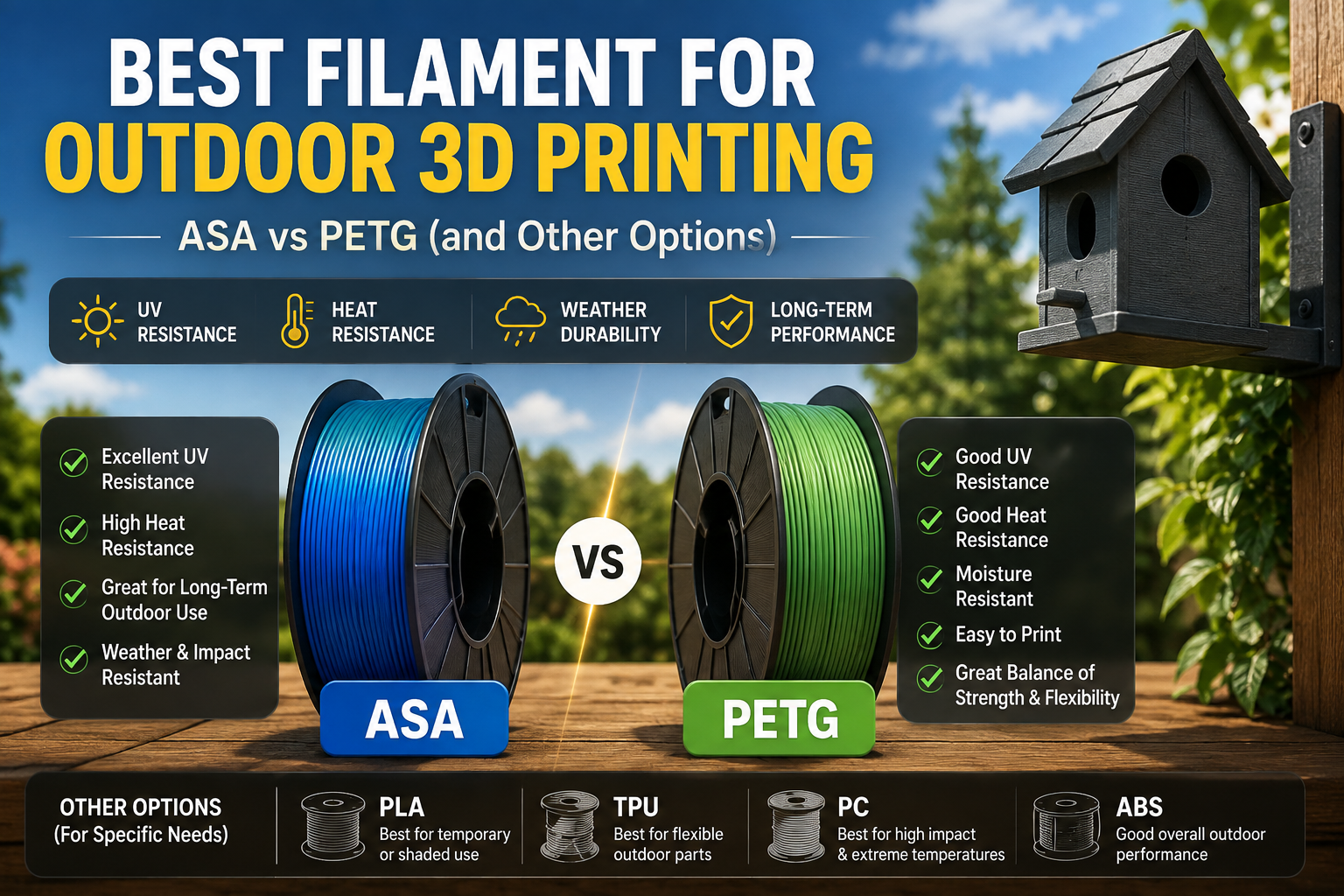
Choosing the best filament for outdoor 3D printing is different from choosing a material for indoor projects. Outdoor parts must deal with sunlight, heat, moisture, temperature changes, and sometimes long-term exposure to harsh weather.
PLA is easy to print, but it can soften in high temperatures and may degrade more quickly under prolonged outdoor exposure. PETG offers better durability and moisture resistance, while ASA is designed to handle UV exposure and outdoor conditions more effectively.
In this guide, we will compare the best filaments for outdoor 3D printing, with a focus on ASA and PETG. We will look at UV resistance, heat resistance, durability, ease of printing, and the types of outdoor projects each material is best suited for.
The best filament for outdoor 3D printing ultimately depends on how much sunlight, heat, moisture, and mechanical stress the finished part will experience.
What Makes a Filament Good for Outdoor 3D Printing?
Outdoor 3D printed parts face several environmental challenges that are less important for indoor projects. Sunlight, heat, rain, humidity, and repeated temperature changes can gradually affect the material and reduce the useful life of a printed part.
UV Resistance
UV resistance is one of the most important factors for parts that will spend long periods in direct sunlight. Prolonged UV exposure can cause some plastics to fade, become brittle, or lose mechanical performance over time. ASA is particularly well suited to applications where long-term UV exposure is expected.
Heat Resistance
Outdoor parts can become much hotter than the surrounding air when they are exposed to direct sunlight. A material that works well indoors may soften or deform when exposed to a hot outdoor environment, so heat resistance should be considered alongside UV resistance.
Moisture and Weather Resistance
Rain, humidity, and repeated wet and dry cycles can also affect outdoor parts. PETG offers good resistance to moisture and is often a practical choice for outdoor projects where extreme UV exposure and heat are not the main concerns.
Printability
The strongest outdoor material is not always the most practical choice. ASA generally requires more careful printing than PETG, while PETG is easier to print on many common desktop printers. Your printer setup, enclosure, ventilation, and experience should therefore be part of the material decision.
For most outdoor projects, the goal is to choose the simplest material that can reliably handle the actual environment. PETG can be enough for moderate outdoor use, while ASA becomes more attractive when prolonged sunlight, heat, and weather exposure are important.
Understanding these factors will help you choose the best filament for outdoor 3D printing based on the conditions your part will actually face.
For detailed material properties and recommended printing requirements, see Prusa Research’s filament material guide.
ASA vs PETG for Outdoor 3D Printing
ASA and PETG are two of the most practical choices for outdoor FDM 3D printing, but they are suited to different conditions. ASA has a stronger advantage when a part will face prolonged UV exposure and higher temperatures, while PETG is easier to print and can be a better choice for moderate outdoor applications.
For more PETG options, see our guide to the best PETG filament for 3D printing.
ASA for Outdoor Printing
ASA is specifically well suited to outdoor applications because of its strong UV and temperature resistance. It is a good choice for parts that will remain outdoors for long periods, especially when direct sunlight and heat are important concerns.
For a broader comparison of materials for different applications, see our PLA vs ABS vs PETG guide.
Excellent UV resistance
Good temperature resistance
Strong and durable
Suitable for long-term outdoor exposure
Good choice for technical outdoor parts
The main trade-off is printability. ASA can warp significantly and generally benefits from a controlled printing environment or enclosure. It also requires higher printing temperatures and good ventilation, so it is less beginner-friendly than PETG.
For demanding applications, the best filament for outdoor 3D printing should be selected with long-term UV exposure and temperature in mind.
PETG for Outdoor 3D Printing
PETG is a practical outdoor material when ease of printing and general durability are more important than maximum UV and temperature resistance. It has good layer adhesion, low warping, and good resistance to water and humidity.
Easy to print
Low warping
Good layer adhesion
Good water and humidity resistance
Suitable for many moderate outdoor applications
PETG can work well for outdoor parts, but ASA is generally the better choice when the part will experience prolonged direct sunlight and higher temperatures. The right choice therefore depends on the actual environment rather than simply choosing the strongest material.
If you are choosing between PLA, PETG, and ABS for a specific project, see our PLA vs ABS vs PETG comparison.
PLA vs PETG vs ASA for Outdoor Use
PLA is one of the easiest 3D printing materials to use, but it is generally not the best choice for parts that will remain outdoors for long periods. Heat and prolonged environmental exposure can cause PLA parts to deform or lose their useful properties.
PETG offers a better balance for many outdoor projects. It is relatively easy to print, has good moisture resistance, and can handle many outdoor applications where temperatures and UV exposure are moderate.
ASA is usually the strongest choice of these three for demanding outdoor applications. Its UV and temperature resistance make it particularly suitable for parts that will spend long periods in direct sunlight or exposed to changing weather conditions.
For more information about heat-resistant materials, see our guide to the best heat-resistant 3D printer filament.
| Feature | PLA | PETG | ASA |
|---|---|---|---|
| Ease of Printing | Excellent | Very Good | More Difficult |
| UV Resistance | Poor | Moderate | Excellent |
| Heat Resistance | Low | Good | Excellent |
| Moisture Resistance | Good | Very Good | Good |
| Warping | Low | Low | Higher |
| Outdoor Use | Limited | Good | Excellent |
| Best For | Temporary/low-heat outdoor parts | Moderate outdoor use | Long-term outdoor exposure |
For a simple outdoor project with moderate environmental exposure, PETG is often the easiest choice. For parts exposed to strong sunlight, high temperatures, and long-term outdoor conditions, ASA is generally the better option. PLA is best reserved for outdoor applications where heat and long-term weather exposure are not significant concerns.
If you are also comparing the two main 3D printing technologies, see our Resin vs FDM guide.
Best Filament for Different Outdoor Applications
The best outdoor filament depends on where the printed part will be used and how much exposure it will receive. A small garden accessory does not necessarily need the same material as a part that stays in direct sunlight throughout the year.
Best Filament for Garden and Outdoor Accessories
PETG is a practical choice for many garden accessories, brackets, holders, and other parts exposed to moisture. It is relatively easy to print and provides a good balance of durability and weather resistance.
The best filament for outdoor 3D printing should also match the expected service life of the garden part.
Best Filament for Parts in Direct Sunlight
For parts that remain in direct sunlight for long periods, ASA is generally the better choice. Its strong UV resistance makes it more suitable for long-term outdoor exposure than standard PLA or PETG.
Best Filament for Outdoor Automotive Parts
ASA can be a good option for many exterior automotive components because these parts may experience direct sunlight, temperature changes, and outdoor weather. The specific application should still be evaluated for mechanical loads and temperature requirements.
Best Filament for Outdoor Enclosures
For outdoor enclosures and protective covers, ASA is often preferred when long-term UV and heat resistance are important. PETG can also be suitable for less demanding environments where easier printing is a priority.
Best Filament for Temporary Outdoor Projects
PLA can be acceptable for temporary outdoor projects or applications where the part will not experience significant heat or prolonged direct sunlight. For long-term outdoor use, PETG or ASA is generally a safer material choice.
Can You Use PLA Outdoors?
PLA can be used outdoors for certain short-term or low-temperature applications, but it is generally not the best filament for long-term outdoor exposure. The main concern is heat: a PLA part exposed to direct sunlight can become significantly hotter than the surrounding air and may deform under load.
PLA is still useful for temporary outdoor projects, decorative parts, prototypes, or applications where the part is protected from direct sunlight and high temperatures. If the part needs to remain outdoors for an extended period, PETG or ASA is usually a better choice.
When PLA Can Work Outdoors
Temporary outdoor projects
Shaded applications
Decorative objects
Parts with little mechanical load
Outdoor use in relatively mild conditions
When You Should Avoid PLA
Long-term direct sunlight exposure
Hot outdoor environments
Parts that support significant loads
Applications where dimensional stability is critical
Parts exposed to large temperature changes
If you are unsure whether PLA will survive a particular outdoor application, consider the highest temperature the part is likely to experience rather than simply looking at the average outdoor temperature. Direct sunlight can heat a printed part considerably.
Heat resistance is one of the main reasons the best filament for outdoor 3D printing is often different from the best indoor filament.
ASA Printing Challenges and How to Avoid Them
ASA offers excellent outdoor performance, but it can be more challenging to print than materials such as PLA and PETG. The main issues are warping, temperature control, and the need for a suitable printing environment.
Warping
ASA can shrink as it cools, which can cause corners and large flat areas to lift from the build plate. Using a suitable build surface, maintaining a stable ambient temperature, and avoiding drafts can help reduce warping.
Enclosure
An enclosure can help maintain a more stable temperature around the print and reduce sudden cooling. This is particularly useful for large ASA parts, where temperature differences can increase the risk of warping.
Ventilation
ASA printing can produce fumes and should be performed in a suitable, well-ventilated environment. Follow the filament manufacturer’s safety recommendations and use appropriate ventilation for your printer setup.
First Layer and Bed Adhesion
A reliable first layer is especially important when printing ASA. Make sure the build plate is clean and properly prepared, and use the manufacturer’s recommended bed temperature and adhesion method as your starting point.
For beginners, PETG is often easier to work with. If you need the stronger UV and heat resistance of ASA, taking the time to create a stable printing environment can make a significant difference in print reliability.
PETG Printing for Outdoor Projects
PETG is often a practical choice for outdoor 3D printing because it combines good durability, moisture resistance, and relatively easy printing. It can be a good alternative to ASA when the part does not need maximum UV and heat resistance.
Why PETG Works Well Outdoors
Good resistance to moisture
Good layer adhesion
Lower warping than ASA
Easier to print on many desktop printers
Suitable for many garden and outdoor accessories
Limitations of PETG Outdoors
PETG is not as well suited as ASA for prolonged exposure to intense UV radiation and high temperatures. A PETG part that is constantly exposed to direct sunlight may eventually experience changes in appearance or mechanical performance.
For moderate outdoor conditions, PETG can provide an excellent balance between printability and durability. For demanding long-term outdoor applications, ASA is generally the safer choice when UV and heat resistance are major priorities.
For moderate weather conditions, the best filament for outdoor 3D printing may be PETG rather than ASA.
Outdoor Filament: What About ABS, TPU, and Other Materials?
ASA and PETG are not the only materials that can be considered for outdoor 3D printing. ABS, TPU, and other engineering filaments can also be useful in specific applications, but their suitability depends on the environment and the properties required from the final part.
ABS
ABS offers good toughness and heat resistance and can be used for some outdoor applications. However, ASA is generally preferred when long-term UV exposure is an important concern because it provides better resistance to sunlight.
For a deeper comparison of ABS with other common filaments, see our PLA vs ABS guide.
TPU
TPU is a flexible filament that can be useful for outdoor parts that need elasticity, impact resistance, or vibration absorption. It is not automatically the best choice for outdoor exposure, so UV resistance and the specific TPU formulation should be considered.
Other Engineering Filaments
More specialized materials such as polycarbonate and other engineering filaments can provide excellent mechanical or temperature performance, but they can also be significantly more difficult to print. For most hobbyist outdoor projects, PETG and ASA provide a more practical starting point.
The most important rule is to choose the material based on the actual conditions the printed part will face. UV exposure, temperature, moisture, mechanical stress, and required flexibility can all change which filament is the best option.
How to Make Outdoor 3D Prints Last Longer
Choosing the right filament is only part of making an outdoor 3D printed part last. Print orientation, wall thickness, infill, layer adhesion, and the environment where the part is installed can all affect its long-term performance.
Choose the Right Material
Start by matching the filament to the environment. PETG can be suitable for many moderate outdoor applications, while ASA is generally a better choice for prolonged exposure to sunlight, heat, and changing weather conditions.
Use More Perimeters
For functional outdoor parts, increasing the number of perimeters can improve the strength of the outer walls. This can be more useful than simply increasing infill because many outdoor parts experience stress around their surfaces and mounting points.
Consider Print Orientation
Print orientation affects layer direction and the strength of the finished part. Orient the model so that important loads are distributed in a way that reduces the risk of separation between layers.
Protect the Printed Part When Necessary
Depending on the application, additional protection such as paint or a suitable coating may help reduce environmental exposure. However, coatings should be treated as an additional layer of protection rather than a substitute for choosing an appropriate outdoor filament.
For long-term outdoor applications, selecting a material with appropriate UV and temperature resistance from the beginning is usually more reliable than trying to compensate for an unsuitable filament later.
Before choosing the best filament for outdoor 3D printing, compare the environmental conditions with the strengths and limitations of each material.
Choosing the best filament for outdoor 3D printing becomes easier when you compare UV exposure, temperature, moisture, and printability together.
Best Outdoor Filament: Quick Comparison
| Feature | PLA | PETG | ASA |
|---|---|---|---|
| UV Resistance | Low | Moderate | Excellent |
| Heat Resistance | Low | Good | Excellent |
| Moisture Resistance | Good | Very Good | Good |
| Ease of Printing | Excellent | Very Good | More Difficult |
| Warping | Low | Low | Higher |
| Long-Term Outdoor Use | Limited | Good | Excellent |
| Best Use | Temporary or shaded projects | Moderate outdoor use | Direct sunlight and demanding conditions |
For most outdoor projects, PETG and ASA are the two materials worth considering first. PETG is easier to print and works well for many moderate outdoor applications, while ASA is the better choice when long-term UV exposure, high temperatures, and demanding weather conditions are major concerns.
Which Outdoor Filament Should You Choose?
Choose PETG for easier printing, good moisture resistance, and moderate outdoor exposure
Choose ASA for long-term exposure to sunlight, heat, and changing weather
Choose PLA only for temporary, shaded, or low-heat outdoor applications
Final Verdict: What Is the Best Filament for Outdoor 3D Printing?
When choosing the best filament for outdoor 3D printing, ASA is generally the strongest option for demanding long-term outdoor applications.
For most demanding outdoor applications, ASA is the best overall choice because it combines strong UV resistance with good heat resistance and durability. It is particularly suitable for parts that will remain outside for long periods and receive direct sunlight.
PETG is the better choice when you want an easier printing experience and the part will face moderate outdoor conditions. It provides good durability and moisture resistance without the additional printing challenges that can come with ASA.
PLA can still be useful for temporary or protected outdoor projects, but it should not be the first choice for long-term exposure to direct sunlight and high temperatures.
There is no single best filament for outdoor 3D printing for every project, so match the material to the conditions rather than choosing based on strength alone.
The best filament for outdoor 3D printing depends on the conditions your part will face. Consider UV exposure, temperature, moisture, mechanical stress, and expected service life before choosing the material.
Quick Recommendation
Best overall for long-term outdoor use: ASA
Best balance of printability and outdoor performance: PETG
Best for temporary or shaded outdoor use: PLA
Best for flexible outdoor parts: TPU, when its specific formulation meets the environmental requirements
The best outdoor filament ultimately depends on the conditions your part will face. Consider UV exposure, maximum temperature, moisture, mechanical stress, and expected service life before choosing the material.
Consider the environment first, then choose the best filament for outdoor 3D printing that meets those requirements.
Frequently Asked Questions
What is the best filament for outdoor 3D printing?
ASA is generally the best choice for demanding long-term outdoor applications because of its strong UV and heat resistance. PETG is often a better option when easier printing and moderate outdoor durability are more important.
Is PETG good for outdoor 3D printing?
Yes. PETG is a good choice for many outdoor projects because it offers good moisture resistance, durability, and relatively easy printing. However, ASA is generally better for prolonged exposure to intense sunlight and high temperatures.
Is ASA better than PETG for outdoor use?
ASA is generally better when maximum UV and heat resistance are important. PETG is easier to print and can be sufficient for outdoor applications with moderate environmental exposure.
Can PLA be used outdoors?
PLA can be used outdoors for temporary, shaded, or low-heat applications, but it is generally not recommended for long-term exposure to direct sunlight and high temperatures.
What filament is best for direct sunlight?
ASA is generally the best choice for FDM parts that will spend long periods in direct sunlight because it offers strong resistance to UV exposure and elevated temperatures.
Does outdoor 3D printing filament need an enclosure?
Not every outdoor filament requires an enclosure. PETG can often be printed without one, while ASA benefits from a stable, controlled printing environment and an enclosure can help reduce warping, especially on larger parts.
Leave a Reply