Choosing between resin and FDM 3D printing can be difficult, especially if you are buying your first 3D printer. Both technologies can produce excellent results, but they use very different printing processes and are designed for different types of projects.
FDM printers use thermoplastic filament to build objects layer by layer, while resin printers use liquid photopolymer resin that is cured with light. The differences affect print quality, speed, materials, maintenance, cost, and the types of models you can create.
In this guide, we will compare resin vs FDM 3D printing and explain the main advantages, disadvantages, and applications of each technology so you can choose the right one for your needs.
What Is FDM 3D Printing?
FDM, or Fused Deposition Modeling, is one of the most common types of 3D printing. An FDM printer creates an object by melting thermoplastic filament and depositing it layer by layer until the complete model is formed.
FDM printers can use materials such as PLA, PETG, ABS, TPU, and ASA. Because filament is generally affordable and easy to store, FDM is a popular choice for beginners, hobbyists, prototyping, and functional parts.
If you are looking for an FDM printer as a beginner, see our guide to the best 3D printers for beginners.
For more information about 3D printing materials and their properties, see the official Prusa Filament Material Guide.
Advantages of FDM Printing
Generally affordable printers
Low material cost
Wide range of filament options
Easy to store filament
Suitable for functional parts
Good for large prints
Easy to experiment with different materials
Disadvantages of FDM Printing
Visible layer lines
Lower fine-detail capability than resin
Some materials require an enclosure
Print quality depends heavily on calibration
Support structures may be needed for complex models
What Is Resin 3D Printing?
Resin 3D printing uses liquid photopolymer resin that is cured with light to create solid objects layer by layer. Most consumer resin printers use technologies such as MSLA or SLA to selectively cure the resin and form each layer of the model.
Resin printing is known for producing highly detailed models with smooth surfaces and excellent small features. This makes it particularly popular for miniatures, figurines, jewelry prototypes, and other projects where fine detail is more important than large-scale functional parts.
Advantages of Resin Printing
Excellent fine detail
Smooth surface finish
Great for miniatures and figurines
Can reproduce very small features
High-quality results at small layer heights
Excellent for detailed models
Disadvantages of Resin Printing
Resin can be more expensive
Requires careful handling
Printed parts need washing and curing
Liquid resin can be messy
Requires proper ventilation and safety precautions
Resin prints can be more brittle than some FDM materials
Resin vs FDM: Print Quality
When it comes to fine detail and surface quality, resin printers generally have the advantage. They can reproduce small features and intricate shapes with smoother surfaces and less visible layer texture.
FDM printers can also produce high-quality models, especially with a well-calibrated machine and suitable settings, but layer lines are usually more visible. FDM is often preferred when the model is larger or when strength and material cost are more important than extremely fine detail.
Which Is Better for Detailed Models?
For miniatures, figurines, jewelry prototypes, and models with very small features, resin is usually the better choice. For larger models, prototypes, and functional parts, FDM can provide an excellent balance between quality, cost, and practicality.
Resin: Better for fine details and smooth surfaces
FDM: Better for larger models and practical everyday parts
Resin: Excellent for miniatures
FDM: More visible layer lines
Resin vs FDM: Strength and Durability
Strength depends on the specific material and the design of the printed part, but FDM generally offers more practical options for strong and durable functional components. Materials such as PETG, ABS, and ASA can produce parts suitable for everyday mechanical use.
Standard resin is often more brittle than common FDM materials, although engineering and tough resins can provide improved mechanical properties. Resin prints can be very strong for their size, but the material should be selected according to the intended application.
Which Is Better for Functional Parts?
For brackets, mounts, enclosures, tools, and other parts that need to withstand regular mechanical stress, FDM is often the more practical choice. Resin is usually better when dimensional detail and appearance are more important than impact resistance.
FDM: More material choices for durable functional parts
FDM: Good options for impact-resistant components
Resin: Excellent detail but standard resins can be brittle
Resin: Tough and engineering resins are available for demanding applications
Resin vs FDM: Printing Speed
Printing speed is not always easy to compare directly because resin and FDM printers build models in different ways. FDM printing speed depends on factors such as nozzle size, layer height, print acceleration, and model complexity.
Resin printers cure an entire layer at once, which can make them efficient when printing multiple small models simultaneously. However, resin printing also includes additional steps such as washing and curing after the print is finished.
For a closer look at resin printing and the software used to prepare resin models, see our guide to the best resin slicer.
Which Is Faster for Multiple Small Models?
Resin can be particularly efficient when several small models are arranged on the build plate because the exposure time for a layer can remain similar regardless of how many models are included. FDM printing time generally increases as more material and model geometry are added.
For a single large or functional part, FDM can be a more practical choice because it avoids the washing and curing steps required by resin printing.
Resin vs FDM: Cost
The total cost of 3D printing includes more than the price of the printer. You also need to consider material costs, replacement parts, maintenance, cleaning supplies, and other accessories required for regular use.
Printer Cost
Both FDM and resin printers are available at different price levels, from affordable beginner machines to advanced models. The best choice depends on the features, build volume, and print quality you need rather than simply choosing the cheapest printer.
Material and Maintenance Cost
FDM filament is generally straightforward to store and use, while resin printing requires liquid resin, cleaning supplies, and post-processing equipment. Resin printers may also require additional consumables such as gloves, cleaning solutions, and replacement components.
FDM: Generally simpler material storage
FDM: Wide range of affordable filament
Resin: Requires liquid resin
Resin: Requires washing and curing
Resin: Additional safety and cleaning supplies are needed
Resin vs FDM: Ease of Use and Maintenance
FDM printing is generally easier to manage for beginners because the workflow is relatively simple. Load the filament, prepare the build plate, start the print, and remove the finished part when it is complete.
Resin printing involves more steps. After printing, the model usually needs to be removed from the build plate, washed to remove uncured resin, and cured before it is ready for use. The printer and surrounding workspace also need regular cleaning.
FDM Maintenance
Clean the build plate
Check and clean the nozzle
Keep the filament dry
Level or calibrate the printer when necessary
Replace worn components when needed
Resin Printer Maintenance
Clean the build plate
Clean the resin vat when necessary
Handle liquid resin carefully
Clean the printer and surrounding workspace
Wash and cure printed models
Replace damaged or worn components when needed
If simplicity and low-maintenance printing are your priorities, FDM is generally the easier technology to live with. Resin can provide better detail, but it requires more post-processing and careful handling.
For beginners interested in FDM, you can also explore our guide to the best 3D printer filament for beginners.
Resin vs FDM: Safety
Safety is another important difference between resin and FDM 3D printing. FDM printing is generally simpler to handle because solid filament is used as the printing material, while resin printing involves liquid photopolymer resin that requires more careful handling.
FDM Safety
Avoid touching hot nozzles and heated surfaces
Use appropriate ventilation when printing certain materials
Keep the printer away from flammable objects
Follow the manufacturer’s safety recommendations
Resin Safety
Avoid direct skin contact with uncured resin
Use appropriate gloves when handling resin
Work in a well-ventilated area
Wear suitable eye protection when appropriate
Keep resin away from food and household surfaces
Follow the resin manufacturer’s safety instructions
For beginners who want the simplest workflow, FDM is generally easier to manage. Resin printing can be used safely when proper handling, ventilation, protective equipment, and manufacturer instructions are followed.
Resin vs FDM: Which Is Better for Beginners?
For most beginners, FDM is the easier technology to start with. FDM printers generally have a simpler workflow, filament is easy to store, and there are many affordable materials available.
Resin can still be an excellent choice for beginners who mainly want to print highly detailed miniatures, figurines, or small models. The main challenge is learning the additional steps involved in washing, curing, cleaning, and safely handling liquid resin.
Choose FDM If
You are completely new to 3D printing
You want an easy printing workflow
You want to print functional parts
You want lower material and maintenance complexity
You want to print larger objects
Choose Resin If
You want extremely detailed models
You mainly print miniatures or figurines
Surface quality is a major priority
You are comfortable with post-processing
You can provide a suitable workspace for resin printing
The best choice ultimately depends on what you want to print. FDM is usually the more versatile and beginner-friendly option, while resin is often the better choice when fine detail and smooth surfaces are the highest priorities.
If you are still choosing your first 3D printer, see our guide to the best 3D printers for beginners.
Which Technology Is Better for Your Projects?
The right 3D printing technology depends mainly on the type of objects you want to create. Neither resin nor FDM is universally better, and each technology has situations where it performs particularly well.
Best for Miniatures and Figurines
Resin is usually the better choice for miniatures and figurines because it can reproduce very small details and produce smooth surfaces with less visible layer texture.
Best for Functional Parts
FDM is generally better suited to functional parts such as brackets, mounts, enclosures, tools, and household components. The wide selection of durable filament materials gives FDM an advantage for many practical applications.
For a closer look at PETG for functional parts, see our guide to the best PETG filament for 3D printing.
Best for Large Prints
FDM is usually the more practical choice for large objects because FDM printers are available with larger build volumes and the material is relatively affordable. Large resin prints can require significant amounts of resin and additional post-processing.
Best for Fine Detail
If extremely fine detail and smooth surfaces are your highest priorities, resin generally has the advantage. FDM can produce detailed models as well, but resin is better suited to very small features and intricate designs.
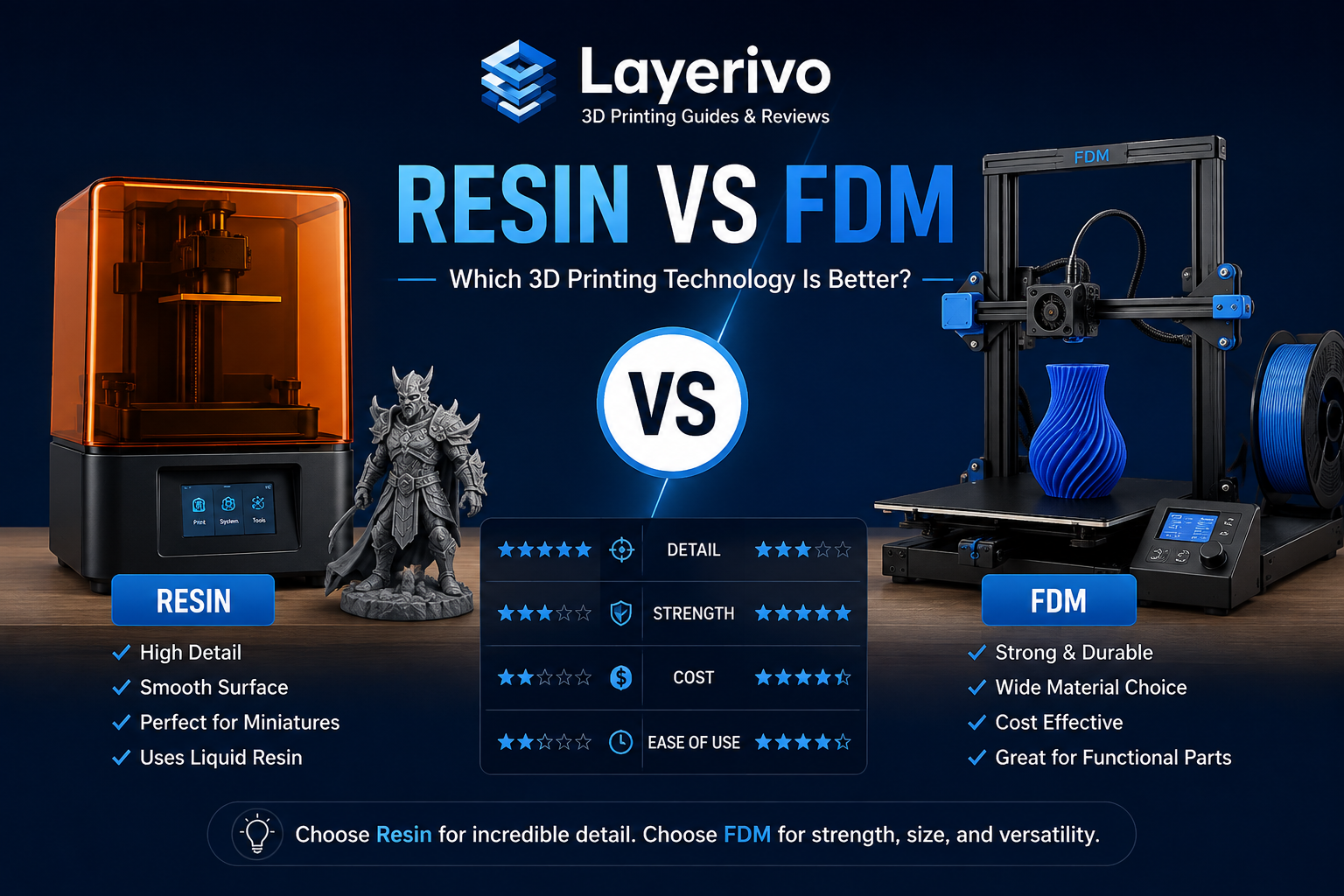
Resin vs FDM: Quick Comparison
| Feature | FDM | Resin |
|---|---|---|
| Print Detail | Good | Excellent |
| Surface Finish | Visible layer lines | Very smooth |
| Strength | Excellent material options | Depends on resin type |
| Material Cost | Generally lower | Generally higher |
| Ease of Use | Easier | More involved |
| Post-Processing | Minimal | Washing and curing required |
| Best For | Functional parts and large prints | Miniatures and detailed models |
Overall, FDM offers a better balance of cost, ease of use, material choice, and practical applications, while resin provides superior detail and surface quality for specialized projects.
Final Verdict: Resin vs FDM
There is no single winner between resin and FDM 3D printing. The better technology depends on your budget, the type of models you want to print, the level of detail you need, and how much post-processing you are willing to do.
For most beginners and general-purpose 3D printing, FDM is the better starting point because it is easier to use, offers a wider range of affordable materials, and works well for both large models and functional parts. Resin is the better choice when extremely fine detail and smooth surfaces are more important than simplicity and ease of maintenance.
Quick Recommendation
Choose FDM for beginners, functional parts, large models, and lower-cost printing
Choose resin for miniatures, figurines, intricate models, and extremely fine detail
Frequently Asked Questions
Is FDM better than resin for beginners?
For most beginners, FDM is the easier technology to start with. It has a simpler workflow, uses easy-to-store filament, and requires less post-processing than resin printing.
Is resin stronger than FDM?
Strength depends on the specific material and the design of the printed part. FDM offers many durable materials such as PETG, ABS, and ASA, while resin printers can also use tough and engineering resins for specific applications.
Which is better for miniatures, resin or FDM?
Resin is generally better for miniatures because it can reproduce very fine details and produce smoother surfaces with less visible layer texture.
Is resin 3D printing more expensive than FDM?
Resin printing can have higher overall running costs because it requires liquid resin, cleaning supplies, and post-processing. FDM filament is generally easier to store and can be less expensive for many everyday projects.
Which 3D printer is easier to maintain?
FDM printers are generally easier to maintain because the printing workflow is simpler and there is less post-processing. Resin printers require additional cleaning, washing, curing, and careful handling of liquid resin.
Should I buy an FDM or resin 3D printer?
Choose FDM if you want an affordable and versatile printer for general-purpose and functional printing. Choose resin if your main priority is extremely fine detail, smooth surfaces, and small models such as miniatures and figurines.
Leave a Reply