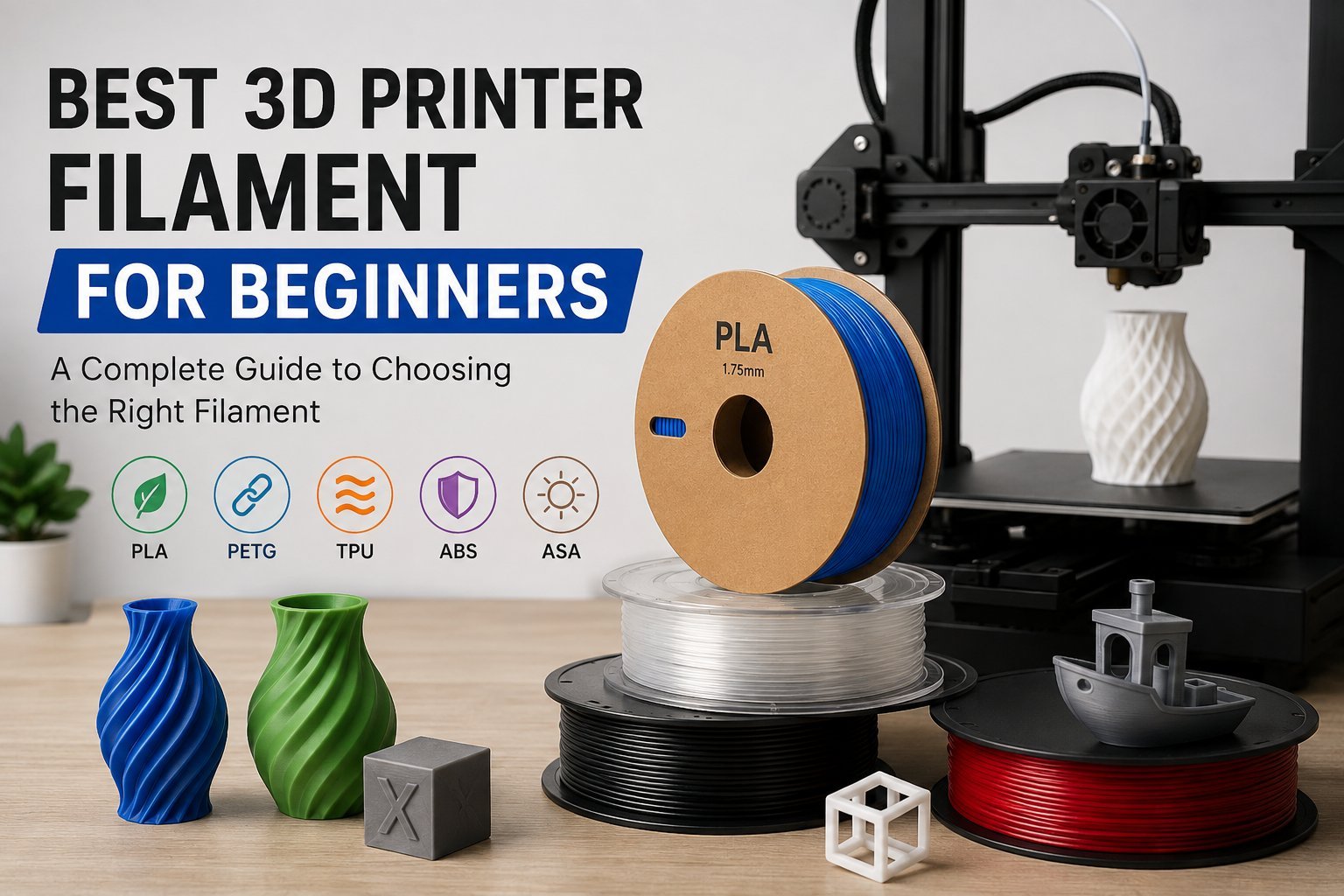
The best 3D printer filament for beginners is usually PLA. It is relatively easy to print, widely available, and doesn’t require the same level of temperature control as materials such as ABS or ASA.
But PLA isn’t the right choice for every project. If you need stronger functional parts, outdoor durability, flexibility, or higher heat resistance, PETG, TPU, ASA, or other materials may be a better option.
This guide explains which filament to buy first, how PLA compares with PETG, and what to look for when choosing your first spool.
Quick Answer: What Is the Best Filament for Beginners?
For most first-time 3D printer users, PLA is the easiest filament to start with.
Our simple recommendation
1- Just learning 3D printing?
Use PLA because it doesn’t need much of an effort and experience from you as a beginner
2- Need stronger functional parts?
PETG would be your choice, since it has a better (elongation at break ) which allows it to bend for a longer distance compared to other materials
3- Need flexible parts?
Use TPU , it’s molecular structure is built on the same principle as rubber,not plastic ,that’s why it has high flexibility ( That doesn’t mean it will be as weak as rubber , they are only similar in term of flexibility)
4- Need outdoor or higher-temperature performance?
Consider ASA , that it’s more resistant to ultraviolet rays which gives it longer time before being noticeably effected.
For your first spool, there’s usually little reason to start with a difficult material simply because it has higher performance on paper.
Best 3D Printer Filament for Beginners
Rather than recommending dozens of nearly identical products, we’ve narrowed the choices down to a few options for different needs.
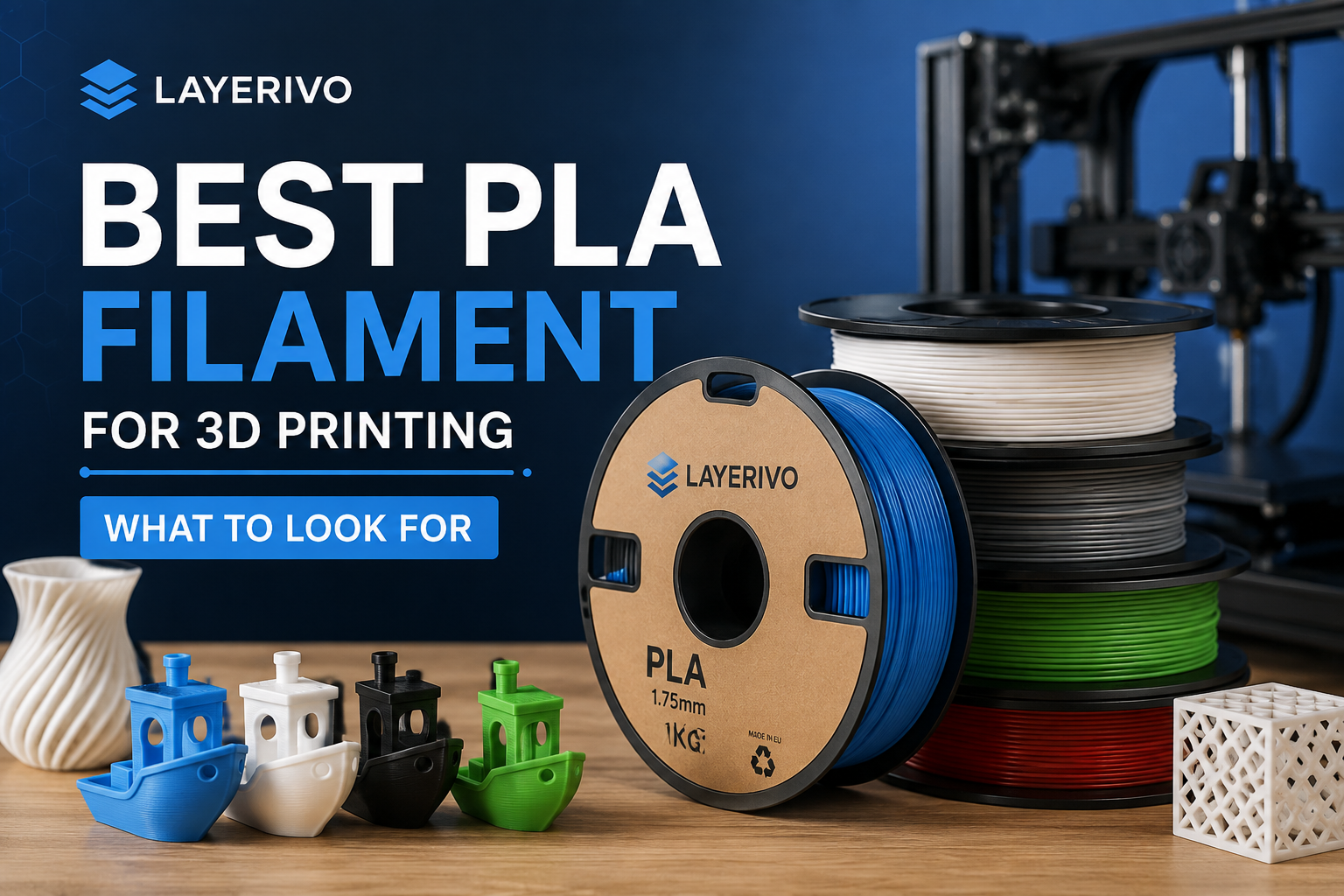
Best Overall PLA: Polymaker PolyTerra PLA
For beginners who want an easy-to-use PLA from an established filament manufacturer.
PolyTerra PLA is designed as an easy-to-print PLA and is a popular option for general-purpose FDM printing.
For more options, see our guide to the best PLA filament for 3D printing.
Why choose it?
1-Easy starting point for beginners
2-Good range of colors
3-Suitable for general-purpose prints
4-Widely used in the 3D-printing community(That allows you to find any help about it easily )
5-Available in common 1.75 mm formats
It’s your ULTIMATE CHOICE for:
- First prints
- Models
- Decorations
- Prototypes
- General household projects
Our verdict: A strong starting option if you want a straightforward PLA without moving into more specialized materials.
Best Budget PLA: SUNLU PLA
Best for: Beginners who want to keep filament costs low.
SUNLU offers several PLA formulations and frequently sells filament in multipacks or at discounted prices.
This can make it attractive if you’re going to print frequently and don’t want to spend premium prices on every spool.
Best for
- Practice prints
- Calibration
- Large models
- Beginners who need several colors
- High-volume printing
Our verdict: In most cases it’s a good candidate when price per kilogram is more important than premium features.
Best Alternative Beginner PLA: Hatchbox PLA
Hatchbox is another established option for users who want conventional PLA without experimenting with more specialized materials.
It is particularly useful as an alternative recommendation because filament availability and pricing can vary significantly between countries.
Best for
*General PLA printing
*Beginners
*Models
*Decorative prints
Best PLA+: eSUN PLA+
PLA+ is marketed as an improved version of conventional PLA, but there is an important caveat:
PLA+ is not a standardized material.
Different manufacturers use different formulations, so PLA+ from one brand shouldn’t automatically be assumed to behave exactly like PLA+ from another.
eSUN PLA+ is one option worth considering if you want a material positioned toward improved toughness while retaining many of the advantages of PLA.
Best for
-Functional prints
-Parts that need more toughness
-Users who have already become comfortable with normal PLA
Best PETG for Beginners: Polymaker PETG
PETG is the material I’d consider after PLA if you need more durability or temperature resistance.
For more PETG options, see our guide to the best PETG filament for 3D printing.
Polymaker’s PETG is designed for FDM printing and is available in a range of colors and spool sizes.
Why choose PETG?
Compared with PLA, PETG generally offers:
- Greater toughness
- Better heat resistance
- Better suitability for functional parts
- Good layer adhesion
But it also introduces some additional challenges.
PETG can produce more stringing and may require more tuning than PLA.
For a first-ever print, I’d still choose PLA.
Best Budget PETG: Overture PETG
If you want to experiment with PETG without immediately buying a premium-priced spool, Overture PETG is another option worth considering.
It is particularly useful for:
- Brackets
- Containers
- Mechanical parts
- Functional household objects
- Parts that need more durability than basic PLA
For more information about PETG properties and printing recommendations, see the Pursa PETG Guide
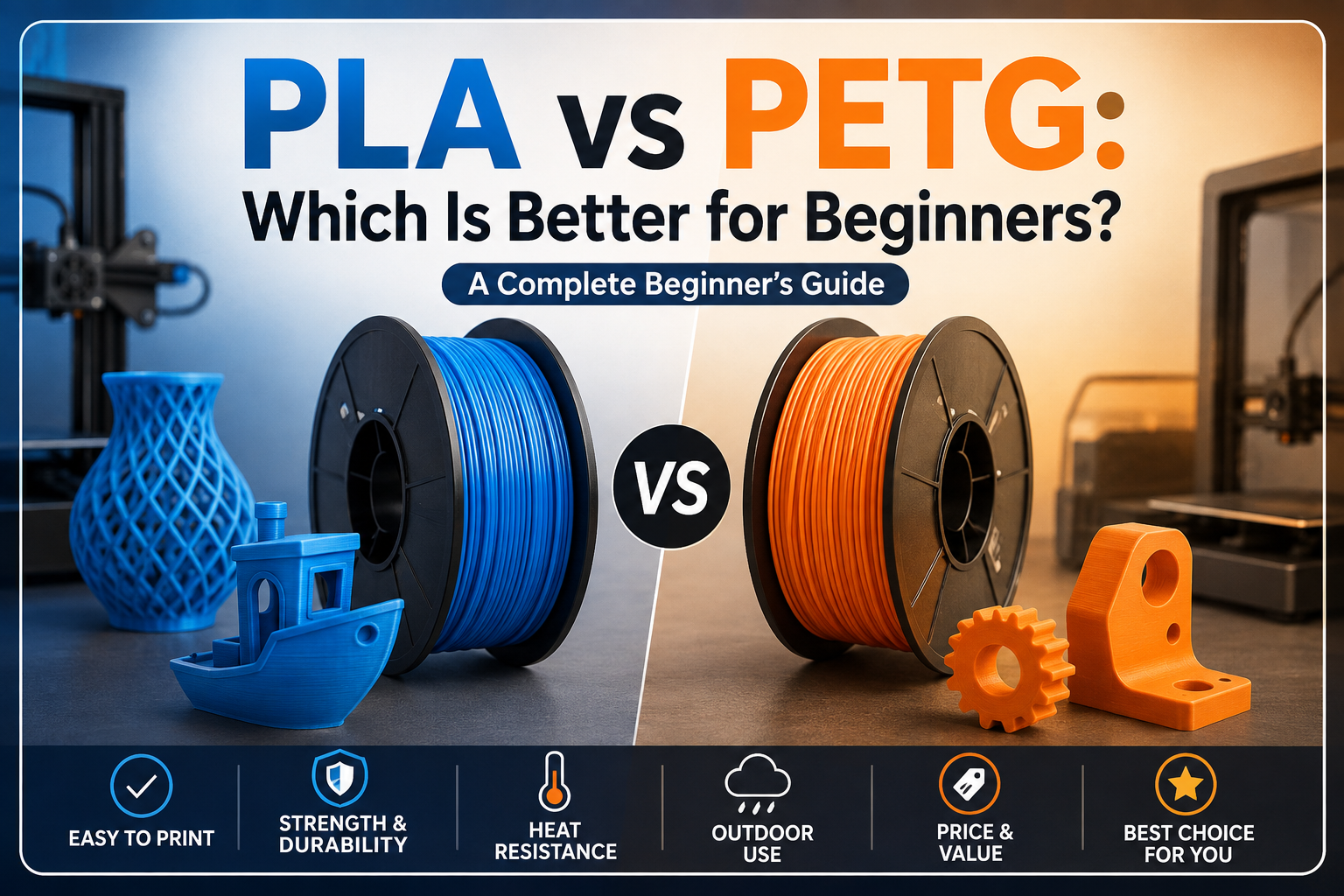
PLA vs PETG for Beginners
This is one of the most important comparisons when choosing the best 3D printer filament for beginners.
| FEATURE | PLA | PETG |
|---|---|---|
| Ease of printing | Easy | Moderate |
| Strength | Good | Very Good |
| Heat resistance | Low | Good |
| Warping | Low | Higher |
| Stringing | Low | Moderate |
| Beginner friendly | Excellent | Good |
| General models | Excellent | Good |
| Functional parts | Good | Excellent |
Which should you choose?
Choose PLA if:
- This is your first 3D printer.
- You’re learning how FDM printing works.
- You’re printing models and decorations.
- You want fewer variables to troubleshoot.
Choose PETG if:
- You need stronger functional parts.
- Your prints will experience more heat.
- You need more toughness.
- You’ve already become comfortable with your printer.
Shortly…..
PLA is the better starting point for most beginners. PETG is the better next step when your projects require additional durability.
For a more detailed comparison, see our dedicated PLA vs PETG guide.
PLA vs PLA+: What’s the Difference?
This is a common source of confusion.
PLA is a specific thermoplastic formulation family, while PLA+ is a marketing term rather than a universal material standard.
That means one manufacturer’s PLA+ can behave differently from another manufacturer’s PLA+.
Don’t automatically assume that:
PLA+ = PLA but stronger in every situation.
Instead, check the manufacturer’s specifications for:
- Recommended nozzle temperature
- Bed temperature
- Strength
- Toughness
- Print speed
- Recommended applications
For a beginner, standard PLA remains the simplest choice.
What Filament Should You Buy for Your First 3D Printer?
If you’re looking for the best 3D printer filament for beginners, PLA is usually the easiest place to start.
If you haven’t chosen your printer yet, see our guide to the best 3D printers for beginners before choosing your filament
Use this simple decision guide:
I just want to learn 3D printing
→ Buy PLA
I want to print strong functional parts
→ Consider PETG
I need flexible parts
→ Consider TPU
I need outdoor durability
Consider [ASA for outdoor 3D printing]
I need higher heat resistance
→ Consider ABS or ASA for higher-temperature applications
But there’s another factor that’s even more important:
Check your printer’s specifications first.
Your printer manufacturer should tell you which filament materials and diameters are supported.
How to Choose 3D Printer Filament
Choosing the best 3D printer filament for beginners isn’t just about the material.
Check the Filament Diameter
The most common diameter for modern consumer FDM printers is:
1.75 mm
But some printers use 2.85 mm / 3 mm filament.
Always check your printer’s specifications before buying.
Check the Manufacturer’s Temperature Range
Different filaments require different printing temperatures.
A manufacturer’s recommended range is a better starting point than copying a random temperature from another printer.
Even two PLA products can have different recommended settings.
Consider Filament Quality
Look for manufacturers that provide clear specifications and consistent product information.
Important specifications include:
- Filament diameter
- Diameter tolerance
- Recommended nozzle temperature
- Recommended bed temperature
- Recommended print speed
- Material composition
Buy the Right Amount
For most beginners, a 1 kg spool is a practical starting point if the price is reasonable.
You can use smaller spools if you want to experiment with several materials or colors without accumulating large amounts of filament.
Don’t Buy Exotic Filament First
When you’re learning, avoid starting with materials that require substantial tuning.
For example, you probably don’t need:
- Carbon-fiber composites
- Very flexible TPU
- High-temperature engineering materials
- Highly specialized blends
Start simple.
Learn your printer first.
Then move into more demanding materials.
What Filament Size Should Beginners Buy?
For most beginners choosing the best 3D printer filament for beginners, 1.75mm is the common choice.
1.75 mm is the common choice.
But this is not universal.
Check the specifications for your exact printer before purchasing.
The wrong diameter can cause feeding and extrusion problems.
Beginner 3D Printing Temperature Guide
These are starting ranges, not universal settings.
PLA
Nozzle: ~190–220°C
Bed: ~45–60°C
Difficulty: Easy
PETG
Nozzle: ~230–250°C
Bed: ~70–85°C
Difficulty: Moderate
TPU
Nozzle: ~210–240°C
Bed: ~40–60°C
Difficulty: Moderate
ABS
Nozzle: ~240–260°C
Bed: ~90–110°C
Difficulty: Advanced
ASA
Nozzle: ~240–260°C
Bed: ~90–110°C
Difficulty: Advanced
Important: Always check the manufacturer’s recommended settings first.
Your actual ideal temperature can depend on:
- Printer
- Nozzle
- Filament brand
- Filament color
- Print speed
- Cooling
- Layer height
For more detailed material and temperature information, see the Prusa Filament Material Guide
Common Filament Problems for Beginners
Even with good filament, you can encounter printing problems.
Stringing
Thin strands of filament appear between separate parts of a print.
Possible causes include:
- Retraction settings
- Printing temperature
- Wet filament
- Travel settings
Don’t immediately assume that the filament itself is defective.
Warping
The corners of the print lift away from the build plate.
This is generally more common with materials such as ABS than with PLA.
Possible causes include:
- Build-plate temperature
- Bed adhesion
- Cooling
- Drafts
- Material choice
Poor Bed Adhesion
If the first layer doesn’t stick properly, check:
- Build plate cleanliness
- Bed leveling
- First-layer height
- Bed temperature
- Nozzle temperature
- First-layer speed
Don’t immediately change filament.
Brittle Filament
If filament snaps easily, moisture, age, material formulation, or storage conditions can be factors.
Wet Filament
Some filaments absorb moisture from the environment.
Signs can include:
- Popping sounds
- Bubbles
- Rough surfaces
- Stringing
- Inconsistent extrusion
This is why proper filament storage matters.
How to Store 3D Printer Filament
If you want consistent printing, don’t leave filament exposed indefinitely.
A simple storage setup can include:
- Airtight storage bag or container
- Desiccant
- Low-humidity environment
- Filament dryer when necessary
PLA is generally less moisture-sensitive than some other materials, but that doesn’t mean it should be stored carelessly.
For materials such as TPU, PETG, and nylon, moisture management becomes increasingly important.
Should Beginners Buy a Filament Dryer?
Not necessarily on day one.
If you’re starting with PLA and printing regularly in a reasonably dry environment, airtight storage with desiccant may be enough.
A filament dryer becomes more useful when:
- You live in a humid environment.
- You print moisture-sensitive materials.
- Your filament has been stored exposed to air.
- You’re experiencing symptoms consistent with wet filament.
This is another product category we’ll cover separately later.
PLA, PETG, TPU, ABS or ASA: Which Should You Choose?
Here’s the simple version:
If you want to compare PLA, ABS, and PETG side by side, see our complete PLA vs ABS vs PETG comparison.
First-ever prints
PLA
Models and decorations
PLA
Stronger functional parts
PETG
Flexible parts
TPU
Outdoor applications
ASA
Higher-temperature applications
ABS / ASA
For most beginners:
Buy PLA first.
Once you’ve learned how your printer behaves, expand into PETG and other materials based on your projects.
Beginner Filament Buying Checklist
Before clicking Buy, check these:
☐ Does my printer use 1.75 mm filament?
☐ Does my printer support this material?
☐ Am I better off starting with PLA?
☐ Is the manufacturer providing recommended temperatures?
☐ Am I buying from a reputable manufacturer?
☐ Do I need 1 kg or a smaller spool?
☐ Do I have somewhere dry to store it?
☐ Am I choosing the material for my actual project?
If you’re unsure, PLA is the safest starting point for most beginners.
Frequently Asked Questions
What is the best 3D printer filament for beginners?
PLA is generally the easiest filament for beginners. It is relatively forgiving and suitable for a wide range of common prints.
Is PLA or PETG better for beginners?
PLA. PETG is useful when you need more durability or heat resistance, but PLA is generally easier to start with.
Is PLA+ better than PLA?
Not necessarily. PLA+ is not a standardized material, so performance varies between manufacturers.
How much filament should a beginner buy?
A 1 kg spool is a practical starting point for many users, although smaller spools can make sense if you want to test several materials or colors.
Does 3D printer filament expire?
Filament doesn’t necessarily “expire” on a fixed date, but storage conditions matter. Moisture and prolonged exposure to the environment can affect printing performance.
Do beginners need a filament dryer?
Usually not immediately if you’re starting with PLA and storing it properly. A dryer becomes more useful as you move into moisture-sensitive materials or if your filament has absorbed moisture.
What size filament should I buy?
1.75 mm is the most common size for modern consumer FDM printers, but always verify your specific printer’s requirements.
Final Recommendation
If this is your first 3D printer and you’re not sure what to buy, keep it simple:
For most beginners, the best 3D printer filament for beginners is PLA.
It’s inexpensive, widely available, relatively easy to print, and suitable for a huge variety of projects.
Once you’ve mastered your first few prints, move to PETG when you need additional strength or heat resistance.
You don’t need five different materials to start 3D printing.
One good spool of PLA and a little practice are enough to get started.
Leave a Reply