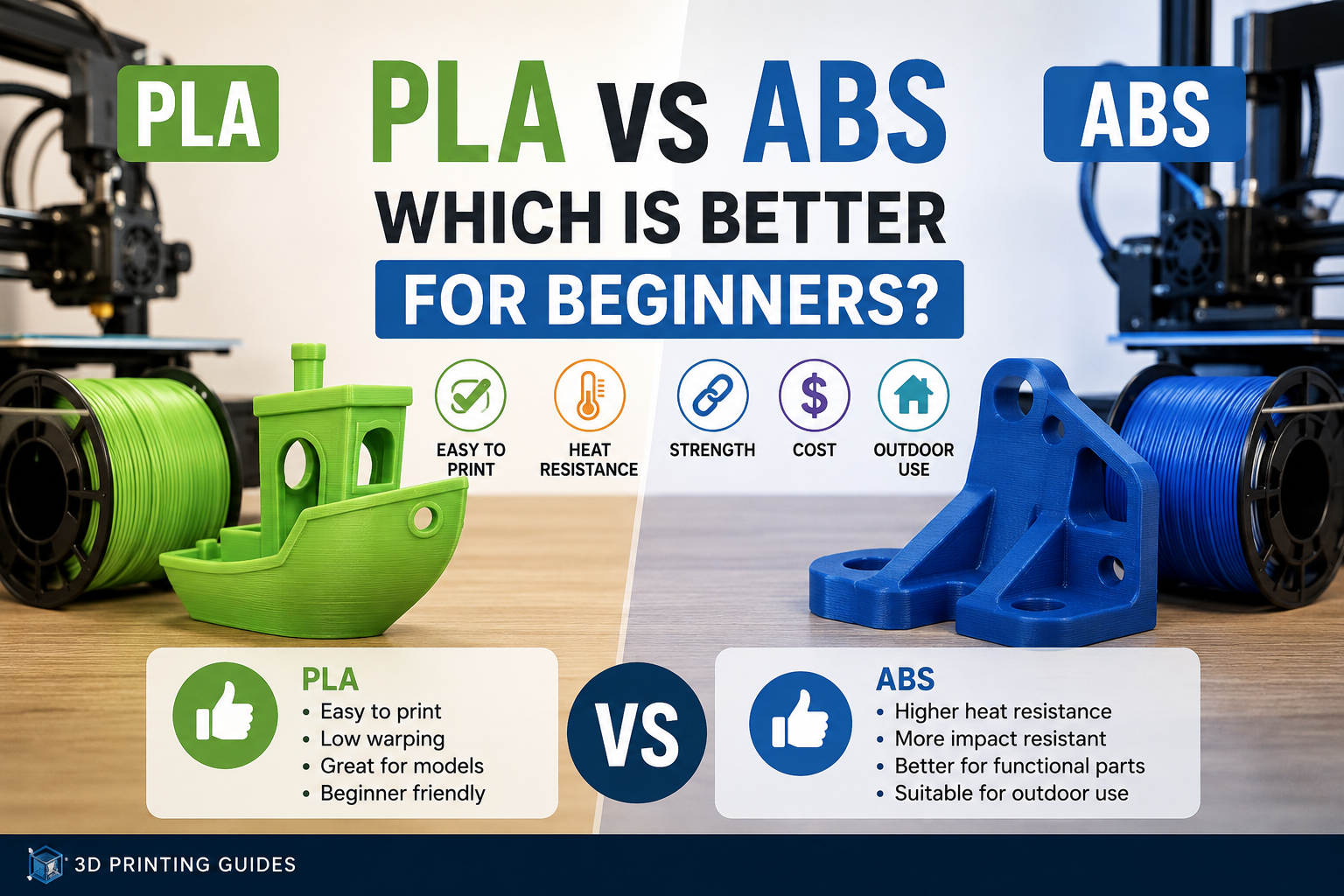
Choosing between PLA and ABS is an important decision when selecting a filament for 3D printing. Both materials are widely used, but they behave very differently when it comes to printing difficulty, strength, heat resistance, durability, and everyday use.
PLA is generally easier to print and is a popular choice for beginners, models, and decorative projects. ABS, on the other hand, offers better heat resistance and can be a better option for functional parts that need to withstand higher temperatures and mechanical stress.
In this guide, we’ll compare PLA vs ABS in detail, including printability, strength, heat resistance, durability, outdoor performance, print quality, cost, and the types of projects each material is best suited for.
PLA vs ABS: Quick Comparison
| Feature | PLA | ABS |
|---|---|---|
| Ease of printing | Excellent | More difficult |
| Printing temperature | Lower | Higher |
| Warping | Low | Higher |
| Stiffness | Higher | Moderate |
| Toughness | Lower | Higher |
| Heat resistance | Lower | Higher |
| Impact resistance | Moderate | Good |
| Surface finish | Excellent | Good |
| Outdoor use | Limited | Better |
| Beginner friendly | Excellent | Moderate |
| Best for | Models & prototypes | Functional parts |
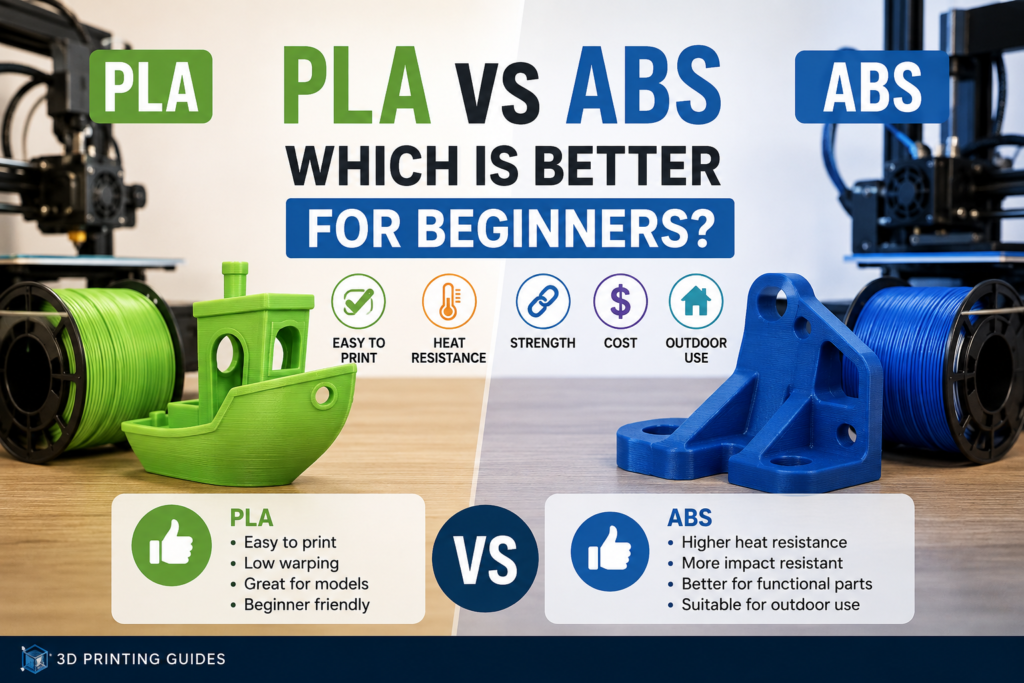
What Is PLA?
PLA, or polylactic acid, is one of the most commonly used materials in FDM 3D printing. It is popular because it is relatively easy to print, widely available, and suitable for a wide range of models and everyday projects.
PLA generally prints at lower temperatures than ABS and usually requires less tuning. It also tends to have low warping and can produce clean surfaces and detailed prints, which makes it especially attractive to beginners.
For many users, PLA is the simplest material to start with when learning the basics of 3D printing.
If you are comparing different filament options, our guide to the best 3D printer filament for beginners can help you choose the right material for your projects.
Advantages of PLA
- Easy to print
- Beginner-friendly
- Requires relatively little tuning
- Produces good surface quality
- Excellent for detailed models and prototypes
- Usually has low warping
- Available in many colors and finishes
- Widely available and generally affordable
Disadvantages of PLA
- Lower heat resistance than ABS
- Can become soft or deform in high temperatures
- Can be relatively brittle compared with tougher materials
- Less suitable for high-stress functional parts
- Not ideal for prolonged exposure to hot outdoor conditions
What Is ABS?
ABS, or acrylonitrile butadiene styrene, is a durable thermoplastic commonly used for functional 3D printed parts. Compared with PLA, ABS generally offers better heat resistance and can withstand more demanding conditions.
However, ABS is more difficult to print successfully. It is more prone to warping and usually benefits from a heated bed, controlled printing conditions, and good bed adhesion. An enclosure can also help reduce temperature changes around the print.
ABS can be a good choice when the final part needs to handle higher temperatures, impact, or mechanical stress. For a beginner who mainly wants easy and reliable prints, however, PLA is usually the simpler option.
Advantages of ABS
- Better heat resistance than PLA
- Good impact resistance
- Suitable for many functional parts
- Can withstand more demanding environments
- Useful for parts exposed to higher temperatures
- Can be sanded and post-processed relatively easily
Disadvantages of ABS
- More difficult to print than PLA
- More prone to warping
- Requires higher printing temperatures
- Benefits from good bed adhesion
- An enclosure can improve printing reliability
- Printing requires good ventilation
- More challenging for beginners
PLA vs ABS: Which Is Easier to Print?
PLA is generally much easier to print than ABS, especially for beginners. PLA usually requires less tuning, has lower printing temperatures, and is less prone to warping.
ABS can produce strong and durable parts, but getting consistent results often requires more careful control of the printing environment. Bed adhesion, temperature changes, cooling, and drafts can all affect the final print.
If your priority is getting reliable prints with minimal troubleshooting, PLA is usually the better starting point. ABS is more suitable once you are comfortable with your printer and need its additional heat resistance or durability.
If you are also comparing other common beginner filaments, see our guide to PLA vs PETG to understand how these two materials differ.
Why PLA Is Easier for Beginners
PLA is forgiving when you are learning how to calibrate a 3D printer. It generally works well without an enclosure and is less affected by temperature changes around the printer.
It also tends to have lower warping, which makes it easier to produce successful first layers and larger prints.
Why ABS Is More Difficult to Print
ABS is more sensitive to temperature changes during printing. Rapid cooling can cause the material to shrink unevenly, which can lead to warping or separation from the build plate.
For better results, ABS often benefits from a heated bed, controlled ambient temperature, and an enclosure. These additional requirements make it more demanding than PLA for someone who is just starting out.
PLA vs ABS: Which Is Stronger?
PLA and ABS have different mechanical properties, so there is no single answer to which material is simply “stronger.”
PLA is relatively stiff and can produce rigid parts with good dimensional stability. ABS is generally tougher and more resistant to impact, which can make it a better choice for parts that may experience repeated stress or physical impacts.
The best choice depends on how the printed part will be used. PLA can be excellent for rigid models, prototypes, and parts that do not experience high temperatures or heavy impacts. ABS can be more suitable for functional parts that need better toughness and durability.
If you want to compare PLA, ABS, and PETG side by side, see our complete PLA vs ABS vs PETG comparison.
Strength vs Stiffness vs Toughness
Strength, stiffness, and toughness describe different properties.
Strength refers to how much stress a material can withstand before failing. Stiffness describes how much a material resists bending or deformation. Toughness describes how well it can absorb energy before breaking.
PLA can be relatively stiff, while ABS is generally tougher and more impact-resistant. This is why the intended use of the printed part matters more than simply asking which material is “stronger.”
Which Is Better for Functional Parts?
ABS can be a good choice for functional parts that need to withstand impact, repeated use, or higher temperatures.
PLA can still work very well for many functional parts when heat and impact are not major concerns. It is often the better option when ease of printing and dimensional stability are more important than maximum toughness.
PLA vs ABS: Which Handles Heat Better?
ABS generally handles higher temperatures better than PLA. This is one of the main reasons ABS is often chosen for functional parts that may be exposed to heat during use.
PLA can soften or deform when exposed to relatively high temperatures, which limits its use around hot equipment or in very warm environments. ABS has better heat resistance and can maintain its shape under conditions where PLA may begin to lose its mechanical stability.
However, the exact temperature performance depends on the specific filament formulation, the design of the printed part, the load it carries, and the environment in which it is used. Always check the manufacturer’s specifications when heat resistance is important.
When Should You Choose ABS for Heat Resistance?
ABS can be a better choice when a printed part will regularly experience higher temperatures than PLA can comfortably handle.
Examples include functional components used near warm equipment, parts exposed to hot environments, and objects that need to maintain their shape when temperatures rise.
If the application involves very high temperatures, however, neither standard PLA nor ABS should automatically be considered suitable. A specialized high-temperature material may be necessary.
For a deeper comparison of high-temperature materials, see our guide to the best heat-resistant 3D printer filament.
Does PLA Melt More Easily Than ABS?
PLA generally loses its mechanical stability at lower temperatures than ABS. In practical applications, a printed part can soften or deform before reaching its actual melting temperature.
For applications where heat resistance is more important than ease of printing, ABS is generally the better choice between the two.
PLA vs ABS for Outdoor Use
ABS is generally a better choice than standard PLA for many outdoor applications because it offers better heat resistance and can handle more demanding environmental conditions.
PLA can work outdoors for decorative or temporary projects, but prolonged exposure to sunlight and heat can cause it to soften, deform, or lose some of its mechanical performance.
ABS can perform better in outdoor environments, especially when the printed part needs to remain functional while exposed to higher temperatures. However, ABS is not automatically the best material for every outdoor application.
For long-term outdoor use with strong sunlight and demanding weather conditions, materials such as ASA may be a better option because they are specifically better suited to UV exposure.
For a more detailed comparison of materials for outdoor printing, see our guide to the best filament for outdoor 3D printing.
Is ABS Waterproof?
ABS has good resistance to moisture, but a 3D printed part is not automatically waterproof simply because it is made from ABS.
Water resistance depends on factors such as wall thickness, layer adhesion, print settings, infill, and the overall design of the part.
If you need a water-resistant printed part, the design and printing process are just as important as the choice of filament.
Is PLA Good for Outdoor 3D Printing?
PLA can be used outdoors for some applications, especially when the part is protected from direct sunlight and high temperatures.
For long-term outdoor use, however, ABS is generally a better option than standard PLA because it can tolerate higher temperatures and more demanding conditions.
PLA vs ABS for Different Projects
The best filament depends on what you plan to print. PLA is usually the better choice for models, decorative objects, prototypes, and projects where ease of printing and appearance are important. ABS becomes more useful when the printed part needs better heat resistance, toughness, or durability.
Choosing the material based on the actual use of the part can help you avoid unnecessary printing problems and get better results.
When to Choose PLA
PLA is a good choice for:
- Beginner projects
- 3D printed models
- Miniatures and detailed objects
- Decorative parts
- Prototypes
- Architecture models
- Parts that do not experience high heat or heavy impact
When to Choose ABS
ABS is a good choice for:
- Functional parts
- Mechanical components
- Parts exposed to higher temperatures
- Impact-resistant applications
- Automotive and workshop projects
- Parts that need more toughness and durability
- Projects where heat resistance is more important than ease of printing
PLA vs ABS for 3D Printer Parts
For simple 3D printer accessories that do not experience much heat or mechanical stress, PLA can work very well.
For parts that need to withstand higher temperatures or repeated mechanical stress, ABS can be a better option.
Before choosing either material, consider the temperature around the part, the amount of mechanical stress it will experience, and whether the part will be exposed to sunlight or other environmental conditions.
PLA vs ABS: Which Is Cheaper?
PLA is often more affordable and easier to find than ABS, which makes it an attractive option for beginners. However, filament prices vary depending on the brand, formulation, color, and retailer.
For most beginners, the price difference should not be the only factor when choosing between PLA and ABS. The better choice is the material that matches the requirements of your project.
If you are still learning how to use your printer, starting with PLA can help you practice without dealing with the additional printing challenges of ABS. Once you need better heat resistance or durability, ABS may be worth the extra effort.
Is PLA Always Cheaper Than ABS?
Not always. Prices can vary significantly between brands and retailers, and premium PLA can sometimes cost more than basic ABS.
Instead of assuming that one material is always cheaper, compare the price per kilogram and check the specifications of the specific filament you are considering.
PLA vs ABS: Printing Temperature and Settings
PLA and ABS require different printing conditions, which is one of the main practical differences between the two materials.
PLA generally prints at lower temperatures and is more forgiving when your settings are not perfectly calibrated. ABS requires higher temperatures and is more sensitive to cooling, drafts, and changes in the surrounding temperature.
The exact settings depend on your printer, nozzle, build surface, filament brand, and print speed. Always use the manufacturer’s recommended settings as your starting point rather than treating a single temperature range as universal.
For more detailed information about filament materials and recommended printing conditions, see the Prusa Filament Material Guide.
Typical PLA Printing Settings
PLA commonly uses lower nozzle and bed temperatures than ABS. It also tends to work well with standard cooling and can produce good results without extensive calibration.
For the exact nozzle temperature, bed temperature, print speed, and cooling settings, check the manufacturer’s recommendations for your specific PLA filament.
Typical ABS Printing Settings
ABS generally requires higher nozzle and bed temperatures than PLA. It also benefits from a stable printing environment because sudden temperature changes can increase the risk of warping.
An enclosure can help maintain a more consistent temperature around the print, especially for larger ABS parts.
Because ABS formulations vary between manufacturers, there is no single set of settings that works perfectly for every spool. Start with the recommended settings provided by the filament manufacturer and make small adjustments when necessary.
Why ABS Is More Prone to Warping
ABS tends to shrink more as it cools, which can cause the corners of a print to lift from the build plate.
Good bed adhesion, an appropriate bed temperature, reduced drafts, and a stable printing environment can all help reduce warping.
This is one of the main reasons ABS can be more challenging for beginners than PLA.
PLA vs ABS: Which Has Better Print Quality?
PLA generally has an advantage when it comes to achieving clean and consistent print quality, especially for beginners. It can produce sharp details, smooth surfaces, and reliable results with relatively little tuning.
ABS can also produce high-quality prints, but achieving consistent results often requires more careful control of temperature, cooling, and bed adhesion. Warping and uneven cooling can affect the appearance of larger ABS prints.
If your main priority is detailed models and an attractive surface finish, PLA is usually the easier choice. If your priority is durability and heat resistance, ABS may be worth the additional printing effort.
Which Is Better for Detailed Prints?
PLA is generally the better choice for highly detailed prints such as miniatures, decorative models, and objects with fine features.
Its predictable printing behavior and lower tendency to warp make it easier to achieve clean details without extensive calibration.
Which Has Better Layer Adhesion?
ABS can produce strong printed parts when it is printed under suitable conditions, but achieving good layer bonding depends heavily on temperature and the surrounding printing environment.
Factors such as nozzle temperature, print speed, cooling, layer height, and ambient temperature can all affect the final strength of the printed part.
PLA vs ABS: Pros and Cons at a Glance
PLA Pros
- Very easy to print
- Beginner-friendly
- Requires relatively little tuning
- Excellent detail and surface quality
- Usually has low warping
- Widely available
- Good choice for models and prototypes
- Generally affordable
PLA Cons
- Lower heat resistance than ABS
- Can soften or deform at higher temperatures
- Can be relatively brittle
- Less suitable for high-stress functional parts
- Not ideal for demanding outdoor applications
ABS Pros
- Better heat resistance than PLA
- Good impact resistance
- Suitable for many functional parts
- Better suited to demanding environments
- Useful for parts exposed to higher temperatures
- Can be post-processed relatively easily
ABS Cons
- More difficult to print
- More prone to warping
- Requires higher printing temperatures
- Benefits from a controlled printing environment
- An enclosure can improve reliability
- More challenging for beginners
PLA vs ABS: Which One Should Beginners Buy?
For most beginners, PLA is the better filament to start with. It is easier to print, requires less tuning, produces good-looking results, and works well for a wide range of common projects.
Choose PLA if you are learning how to use your 3D printer, printing models or decorative objects, or simply want the easiest path to successful prints.
Choose ABS when you need better heat resistance, higher impact resistance, or a material that can handle more demanding functional applications.
There is no need to choose only one material forever. Starting with PLA allows you to learn the basics of 3D printing, while ABS can be added later when your projects require properties that PLA cannot provide as easily.
Choose PLA If:
- You are completely new to 3D printing
- You want the easiest material to print
- You are making models, miniatures, or decorations
- You want good surface quality and fine details
- You do not need high heat resistance
Choose ABS If:
- You need better heat resistance
- Your parts may experience repeated impacts
- You are making functional or mechanical parts
- You need a material for more demanding environments
- You are comfortable with additional printing and calibration requirements
Frequently Asked Questions
Is PLA better than ABS for beginners?
For most beginners, yes. PLA is generally easier to print, requires less tuning, and is less prone to warping. ABS is better suited to users who need higher heat resistance or more durable functional parts.
Is ABS stronger than PLA?
ABS is generally tougher and more impact-resistant than PLA, while PLA is often stiffer. The better material depends on the type of load and how the printed part will be used.
3. Is ABS harder to print than PLA?
Yes. ABS is generally more difficult to print because it is more prone to warping and is more sensitive to temperature changes. PLA is usually the easier material for beginners.
4. Which is better for outdoor 3D printing, PLA or ABS?
ABS is generally better than standard PLA for many outdoor applications because it handles higher temperatures better. For long-term exposure to strong sunlight, however, ASA may be a better choice.
5. Which handles heat better, PLA or ABS?
ABS generally has better heat resistance than PLA, making it more suitable for parts that will be exposed to higher temperatures during use.
6. Can ABS replace PLA?
ABS can replace PLA for many functional applications, but it is not always the better choice. PLA remains easier to print and is often preferable for models, decorations, and beginner projects.
7. Should I start with PLA or ABS?
If this is your first time 3D printing, start with PLA. Once you are comfortable with your printer and need better heat resistance or impact resistance, ABS is a useful material to learn next.
8. Is PLA cheaper than ABS?
PLA is often affordable and widely available, but prices vary by brand, formulation, and retailer. Compare the price per kilogram rather than assuming one material is always cheaper.
Final Recommendation
PLA is the better starting point for most beginners because it is easy to print, widely available, affordable, and suitable for a wide range of projects.
ABS is the better choice when you need higher heat resistance, better impact resistance, or a material that can handle more demanding functional applications.
If you are buying your first spool, start with PLA and learn how your printer behaves. Once you are comfortable with the basics, consider ABS when your projects require its additional properties.
The best choice ultimately depends on how you plan to use your 3D printed part. For simple models and beginner projects, PLA is usually the easier option. For demanding functional parts and higher-temperature environments, ABS can be the better choice.
Leave a Reply