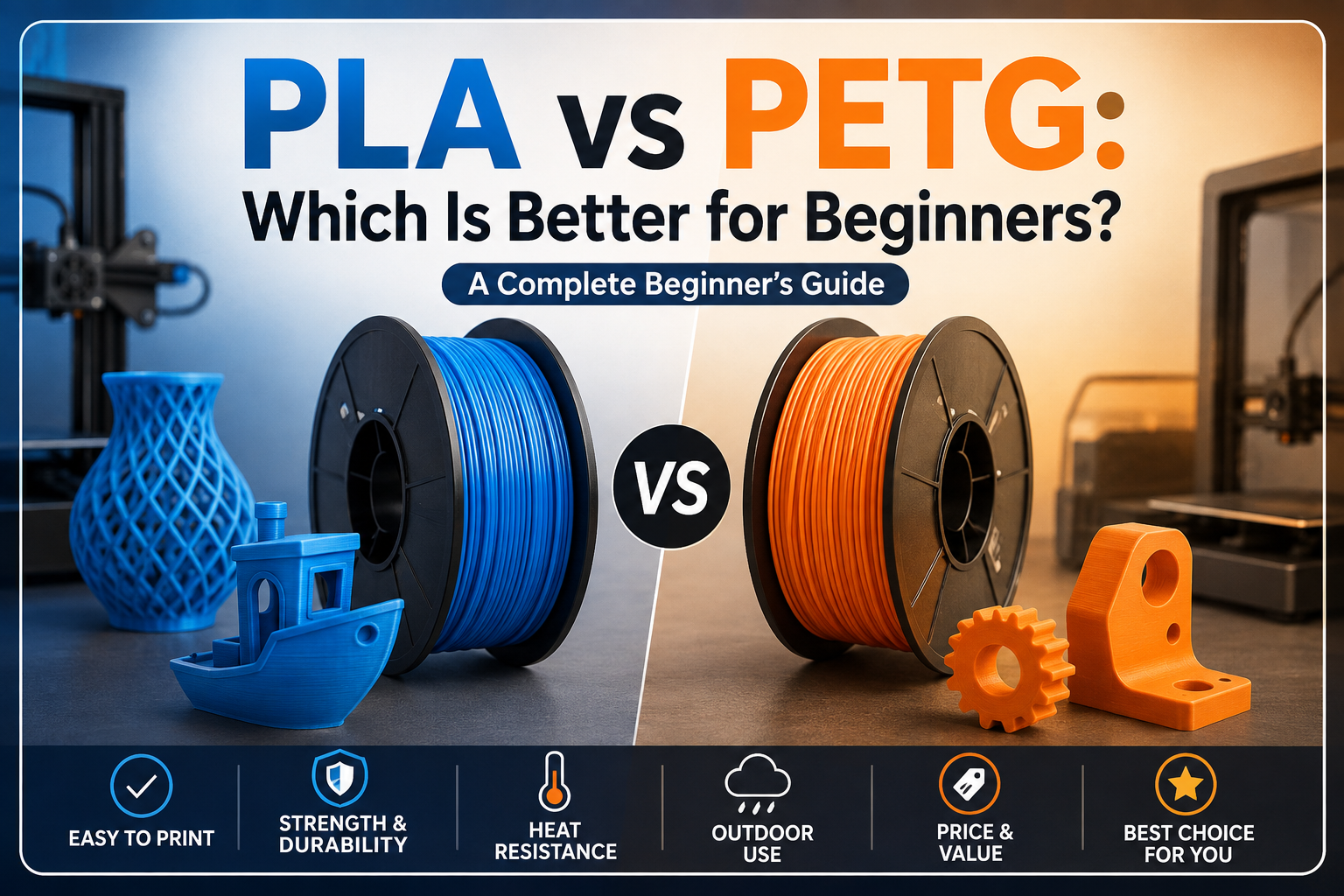
Choosing between PLA and PETG is one of the first decisions many beginners face when starting with 3D printing. Both filaments are popular, affordable, and capable of producing high-quality prints,but choosing the right filament depends on your project.
For most beginners, PLA is the easier material to start with because it is simple to print and requires less tuning. PETG, however, can be a better choice when you need stronger, tougher, or more heat-resistant parts.
In this guide, we’ll compare PLA vs PETG in detail, including their advantages, disadvantages, printing requirements, strength, heat resistance, outdoor performance, and the types of projects each material is best suited for.
PLA vs PETG: Quick Comparison
| Feature | PLA | PETG |
|---|---|---|
| Ease of printing | Excellent | Good |
| Printing temperature | Lower | Higher |
| Stringing | Low | More common |
| Warping | Low | Low to moderate |
| Stiffness | Higher | Lower |
| Toughness | Lower | Higher |
| Heat resistance | Lower | Higher |
| Surface finish | Excellent | Good |
| Fine details | Excellent | Good |
| Outdoor use | Limited | Better |
| Best for beginners | Yes | Yes, with some tuning |
What Is PLA?
PLA, or polylactic acid, is one of the most widely used materials in 3D printing. It is made from renewable plant-based resources and is known for being easy to print, making it a popular choice for beginners.
PLA usually prints at relatively low temperatures and generally requires less tuning than many other 3D printing materials. It also produces good surface quality and can capture fine details, which makes it especially useful for models, prototypes, decorative objects, and everyday beginner projects.
Another advantage of PLA is its wide availability. It comes in many colors and finishes, and most modern FDM 3D printers can print standard PLA without requiring specialized equipment.
If you are still deciding which filament to buy, our guide to the best 3D printer filament for beginners can help you compare the most common options.
Advantages of PLA
- Easy to print and beginner-friendly
- Requires relatively little tuning
- Produces good surface quality
- Excellent for detailed models and prototypes
- Available in a wide range of colors and finishes
- Usually has low warping
- Widely available and affordable
Disadvantages of PLA
- Lower heat resistance than PETG
- Can be relatively brittle compared with tougher materials
- Less suitable for parts that experience repeated impact or flexing
- Not the best choice for hot outdoor environments
- Can soften or deform when exposed to higher temperatures
What Is PETG?
PETG, or polyethylene terephthalate glycol-modified, is another popular filament for FDM 3D printing. It is generally tougher and more heat-resistant than PLA, making it useful for functional parts that need to handle more demanding conditions.
PETG is still relatively accessible for beginners, but it usually requires more attention to printing settings than PLA. It can produce more stringing, may require better retraction tuning, and can behave differently depending on the printer, build surface, and filament brand.
For beginners, PETG is often a good second material to learn after becoming comfortable with PLA.
Advantages of PETG
- Better heat resistance than PLA
- Higher toughness for many functional applications
- Good layer adhesion
- Suitable for functional and mechanical parts
- Better suited to moderate outdoor use than PLA
- Good balance between printability and durability
Disadvantages of PETG
- More stringing than PLA in many cases
- Requires higher printing temperatures
- Can require more tuning and calibration
- Can be more sensitive to printing conditions
- May adhere very strongly to some build surfaces
PLA vs PETG: Which Is Easier to Print?
PLA is generally easier to print than PETG, especially for someone using a 3D printer for the first time. PLA usually requires less tuning and is more forgiving when your settings are not perfectly calibrated.
PETG can still be beginner-friendly, but it tends to require more attention to temperature, retraction, cooling, and first-layer settings. Stringing is also more common with PETG, so you may need to adjust your printer settings to get clean results.
If your main priority is getting your first successful prints with minimal troubleshooting, PLA is usually the better starting point. Once you are comfortable with your printer, learning PETG can give you access to more durable and functional materials.
Why PLA Is Easier for Beginners
PETG can produce excellent prints, but it often requires more careful tuning than PLA. Stringing, first-layer behavior, and surface adhesion can all require additional attention.
The exact settings depend on your printer and filament, so it is best to start with the manufacturer’s recommended settings and adjust them gradually when necessary.
PLA vs PETG: Which Is Stronger?
The answer depends on what you mean by “stronger.” PLA and PETG have different mechanical properties, so neither material is automatically better for every type of load or application.
PLA is relatively stiff and can produce rigid parts with good dimensional stability. PETG, on the other hand, is generally tougher and more resistant to impact and bending. This makes PETG a strong option for functional parts that may experience repeated stress or occasional impacts.
For this reason, PETG is often the better choice when toughness and durability matter, while PLA can be preferable when stiffness, sharp details, and ease of printing are more important.
Strength vs Stiffness vs Toughness
Strength, stiffness, and toughness are not the same thing.
Strength describes how much stress a material can withstand before failing. Stiffness describes how much a material resists bending or deformation. Toughness describes how well a material can absorb energy before breaking.
PLA can be quite stiff, while PETG is generally more flexible and tougher. Therefore, saying that one material is simply “stronger” can be misleading without considering how the printed part will actually be used.
Which Is Better for Functional Parts?
For many functional parts, PETG is the better choice because its toughness and durability can be more useful than the rigidity of PLA.
PETG can be a good option for brackets, containers, mounts, and other parts that may experience impact, bending, or repeated use. PLA can still work well for functional parts that do not face high temperatures or significant mechanical stress.
PLA vs PETG: Which Handles Heat Better?
PETG generally handles higher temperatures better than PLA. This makes it a more suitable choice for parts that may be exposed to moderate heat during normal use.
PLA can soften or deform when exposed to relatively high temperatures, which can be a problem for parts used near heat sources or inside hot environments. PETG has better heat resistance, although it is not a high-temperature engineering material.
The actual temperature performance depends on the specific filament formulation, the printed part’s design, the load placed on it, and the conditions in which it is used. Always check the manufacturer’s specifications when temperature resistance is important.
When Should You Choose PETG for Heat Resistance?
PETG can be a better choice when a printed part will regularly experience more heat than PLA can comfortably handle.
Examples can include functional parts used near warm equipment, components exposed to sunlight, or objects that need to maintain their shape in moderately warm environments.
However, if a part will be exposed to very high temperatures, neither standard PLA nor PETG should automatically be considered suitable. A more heat-resistant engineering material may be necessary.
Does PLA Melt More Easily Than PETG?
PLA generally begins to lose its mechanical stability at lower temperatures than PETG. This does not mean that either material simply melts during normal use; printed parts can soften and deform before reaching a true melting temperature.
For practical 3D printing applications, PETG is usually the better choice when heat resistance is more important than ease of printing.
PLA vs PETG for Outdoor Use
PETG is generally a better choice than PLA for many outdoor applications because it offers better resistance to heat, moisture, and everyday mechanical stress.
PLA can still be used outdoors for decorative objects or temporary applications, but prolonged exposure to sunlight and heat can cause it to soften, deform, or lose some of its mechanical performance.
PETG is more suitable when a printed part needs to remain functional outdoors, especially when it may experience moderate heat, moisture, or repeated handling.
However, PETG is not automatically the best material for every outdoor application. If a part will be exposed to intense sunlight, high temperatures, or demanding outdoor conditions for long periods, materials such as ASA may be a better option.
Is PETG Waterproof?
PETG itself has good resistance to moisture, but a 3D printed part is not automatically waterproof simply because it is made from PETG.
The final result depends on factors such as wall thickness, layer adhesion, print settings, infill, and the overall design of the part.
If you need a genuinely water-resistant part, the design and printing process are just as important as the choice of filament.
Is PLA Good for Outdoor 3D Printing?
PLA can work for some outdoor projects, especially when the part is protected from direct sunlight and high temperatures.
For long-term outdoor use, however, PETG is generally a safer choice because it handles heat and environmental exposure better than standard PLA.
PLA vs PETG for Different Projects
The best filament depends on what you are planning to print. PLA is usually the better choice for simple models, decorative objects, prototypes, and projects where ease of printing and appearance matter most. PETG becomes more useful when the printed part needs additional toughness, durability, or heat resistance.
Choosing the material based on the actual use of the part can help you avoid unnecessary printing problems and get better results.
When to Choose PLA
PLA is a good choice for:
- Beginner projects
- 3D printed models
- Miniatures and detailed objects
- Decorative parts
- Prototypes
- Architecture models
- Parts that do not experience high heat or heavy impact
When to Choose PETG
PETG is a good choice for:
- Functional parts
- Brackets and mounts
- Containers
- Mechanical parts
- Parts exposed to moderate heat
- Outdoor accessories
- Projects that require more toughness or durability
PLA vs PETG for 3D Printer Parts
For simple printer accessories and parts that do not experience much heat or mechanical stress, PLA can work very well.
For parts that need to withstand more heat, impact, or repeated use, PETG is often the safer option.
Before choosing either material, consider the temperature around the part, the amount of mechanical stress it will experience, and how much flexibility or toughness you need.
PLA vs PETG: Which Is Cheaper?
PLA is often one of the more affordable 3D printing filaments, which is another reason it is popular with beginners. PETG can also be reasonably priced, but the cost varies depending on the brand, formulation, color, and spool size.
For most beginners, the price difference between PLA and PETG should not be the only factor when choosing a filament. The better choice is the material that matches the requirements of your project.
If you are still learning how to use your printer, starting with an affordable PLA spool can help you practice without spending too much on filament. Once you need the additional properties of PETG, the higher cost of a particular spool may be justified.
Is PLA Always Cheaper Than PETG?
Not always. Filament prices can change significantly between brands and retailers, and premium PLA can sometimes cost more than basic PETG.
Instead of assuming that one material is always cheaper, compare the price per kilogram and check the specifications of the specific filament you are considering.
PLA vs PETG: Printing Temperature and Settings
PLA and PETG require different printing conditions, which is one of the main practical differences beginners notice when switching between the two materials.
PLA generally prints at lower temperatures and is more forgiving when your settings are not perfectly calibrated. PETG requires higher temperatures and may need more careful control of retraction, cooling, and first-layer settings.
The exact settings depend on your printer, nozzle, build surface, filament brand, and print speed. Always use the manufacturer’s recommended settings as your starting point rather than treating a single temperature range as universal.
For additional material information and recommended printing ranges, see the Prusa Filament Material Guide.
If you are still choosing a printer, our guide to the best 3D printers for beginners explains what to look for before buying.
Typical PLA Printing Settings
PLA commonly uses lower nozzle and bed temperatures than PETG. It also tends to work well with standard cooling and can produce good results without extensive calibration.
For the exact nozzle temperature, bed temperature, print speed, and cooling settings, check the manufacturer’s recommendations for your specific PLA filament.
Typical PETG Printing Settings
PETG generally requires higher printing temperatures than PLA and can benefit from careful retraction and cooling adjustments.
Because PETG formulations vary between manufacturers, there is no single set of settings that works perfectly for every spool. Start with the recommended settings provided by the filament manufacturer and make small adjustments if necessary.
Why PETG Can String More Than PLA
Stringing occurs when small strands of molten filament remain between separate parts of a print. PETG is often more prone to stringing than PLA because of the way it behaves during travel moves.
If you notice excessive stringing with PETG, check your retraction settings, nozzle temperature, travel speed, and filament moisture before assuming that the filament is defective.
PLA vs PETG: Which Has Better Print Quality?
PLA generally has an advantage when it comes to ease of achieving clean-looking prints, especially for beginners. It can produce sharp details, smooth surfaces, and consistent results with relatively little tuning.
PETG can also produce high-quality prints, but getting the same level of surface quality may require more careful tuning. Stringing, small surface imperfections, and first-layer behavior can be more noticeable if the settings are not well adjusted.
If your main priority is detailed models and an attractive surface finish, PLA is usually the easier choice. If your priority is durability and functional performance, PETG may be worth the additional tuning.
Which Has Better Layer Adhesion?
PETG is known for good layer adhesion, which can be useful for functional parts that need to remain durable during use.
However, strong layer adhesion alone does not determine the overall strength of a printed object. Print orientation, wall thickness, infill, temperature, and the design of the part can all have a significant effect on its final performance.
PLA vs PETG: Pros and Cons at a Glance
PLA Pros
- Very easy to print
- Beginner-friendly
- Excellent detail and surface quality
- Low tendency to warp
- Widely available
- Good choice for models and prototypes
- Usually affordable
PLA Cons
- Lower heat resistance
- Can be more brittle
- Less suitable for high-stress functional parts
- Not ideal for prolonged exposure to high outdoor temperatures
PETG Pros
- Better heat resistance than PLA
- Good toughness and durability
- Good layer adhesion
- Suitable for functional parts
- Better suited to moderate outdoor use
PETG Cons
- More prone to stringing
- Requires higher printing temperatures
- Usually needs more tuning than PLA
- Can adhere very strongly to some build surfaces
- Surface finish can require more tuning
PLA vs PETG: Which One Should Beginners Buy?
For most beginners, PLA is the better filament to start with. It is easier to print, requires less tuning, produces good-looking results, and works well for a wide range of common projects.
Choose PLA if you are learning how to use your 3D printer, printing models or decorative objects, or simply want the easiest path to successful prints.
Choose PETG when you need more toughness, better heat resistance, or a material that is better suited to functional parts and moderate outdoor use.
There is no need to choose only one material forever. Starting with PLA allows you to learn the basics of 3D printing, while PETG is a useful next step when your projects require properties that PLA cannot provide as easily.
Choose PLA If:
- You are completely new to 3D printing
- You want the easiest material to print
- You are making models, miniatures, or decorations
- You want good surface quality and fine details
- You do not need high heat resistance
Choose PETG If:
- You need tougher functional parts
- Your prints may experience moderate heat
- You need better durability
- You are making brackets, mounts, or mechanical parts
- You need a material better suited to moderate outdoor use
Frequently Asked Questions
Is PLA better than PETG for beginners?
For most beginners, yes. PLA is generally easier to print and requires less tuning than PETG. PETG becomes a better option when you need more toughness, durability, or heat resistance.
Is PETG stronger than PLA?
PETG is generally tougher and more impact-resistant than PLA, while PLA is often stiffer. Which material is stronger depends on the type of load and how the printed part will be used.
Is PETG harder to print than PLA?
Usually, yes. PETG can require more tuning and is more prone to issues such as stringing. PLA is generally more forgiving and easier for beginners.
Which is better for outdoor 3D printing, PLA or PETG?
PETG is generally better for moderate outdoor use because it handles heat and environmental exposure better than standard PLA. For demanding outdoor conditions, materials such as ASA may be more suitable.
Which handles heat better, PLA or PETG?
PETG generally has better heat resistance than PLA. However, the actual performance depends on the specific filament and the conditions in which the printed part will be used.
Can PETG replace PLA?
PETG can replace PLA for many functional applications, but it is not always the better choice. PLA remains easier to print and is often preferable for detailed models, decorations, and beginner projects.
Should I start with PLA or PETG?
If this is your first time 3D printing, start with PLA. Once you are comfortable with your printer and need more durability or heat resistance, PETG is a useful material to learn next.
Is PLA cheaper than PETG?
PLA is often affordable, but prices vary by brand, formulation, color, and retailer. Compare the price per kilogram rather than assuming one material is always cheaper.
Final Recommendation
When comparing PLA vs PETG, the best choice depends on what you plan to print and how you expect the finished part to perform.
PLA is the best starting point for most beginners because it is easy to print, widely available, affordable, and suitable for a wide range of projects.
PETG is the better choice when you need more toughness, durability, heat resistance, or better performance for functional and moderate outdoor applications.
If you are buying your first spool, start with PLA and learn how your printer behaves. Once you are comfortable with the basics, add PETG to your filament collection when your projects require its additional properties.
The best choice is ultimately the material that matches the way you plan to use your 3D prints.
Leave a Reply