Choosing the right 3D printing material is just as important as choosing the printer itself. The material determines how a printed part looks, feels, and performs, including its strength, flexibility, heat resistance, durability, and ability to withstand environmental conditions.
Some materials are easy to print and ideal for beginners, while others are designed for functional parts that need to handle mechanical stress, high temperatures, or repeated movement. There are also specialized materials for detailed models, flexible components, industrial applications, and engineering prototypes.
This guide explores the main types of 3D printing materials, explains their properties and practical applications, and compares their advantages and limitations. Whether you are choosing your first filament or looking for a material for a demanding project, you will learn how to select an option that matches your printer and intended use.
What Are 3D Printing Materials?
3D printing materials are the substances used to build physical objects layer by layer. They come in different forms, including plastic filaments, liquid photopolymer resins, metal powders, and other specialized materials.
The material used depends largely on the 3D printing technology. A filament-based printer, for example, melts thermoplastic material and deposits it through a nozzle, while a resin printer uses light to cure liquid photopolymer into solid layers. Industrial technologies may use powdered polymers or metals to produce more specialized parts.
Understanding these differences is important because materials designed for one printing technology cannot automatically be used with another.
If you are still deciding which printing technology to use, read our detailed Resin vs FDM comparison to understand their differences in materials, print quality, cost, and practical applications.
Main Categories of 3D Printing Materials
Most materials can be grouped according to the printing process they are designed for:
1. Thermoplastic Filaments (FDM/FFF)
Thermoplastic filaments are commonly used in Fused Deposition Modeling (FDM), also known as Fused Filament Fabrication (FFF). The printer heats the filament until it softens or melts, then deposits it through a nozzle to build the object layer by layer.
Common examples include:
- PLA: A beginner-friendly material commonly used for prototypes, models, and decorative objects.
- PETG: A versatile filament used for functional parts that need a balance of toughness and printability.
- ABS: A durable thermoplastic used for functional components and enclosures.
- TPU: A flexible material used for rubber-like parts, protective components, and flexible prototypes.
- Nylon (PA): An engineering material used for durable parts, mechanical components, and applications involving wear.
Other options include ASA, polycarbonate (PC), polypropylene (PP), and high-performance thermoplastics.
2. Photopolymer Resins (SLA, DLP, and MSLA)
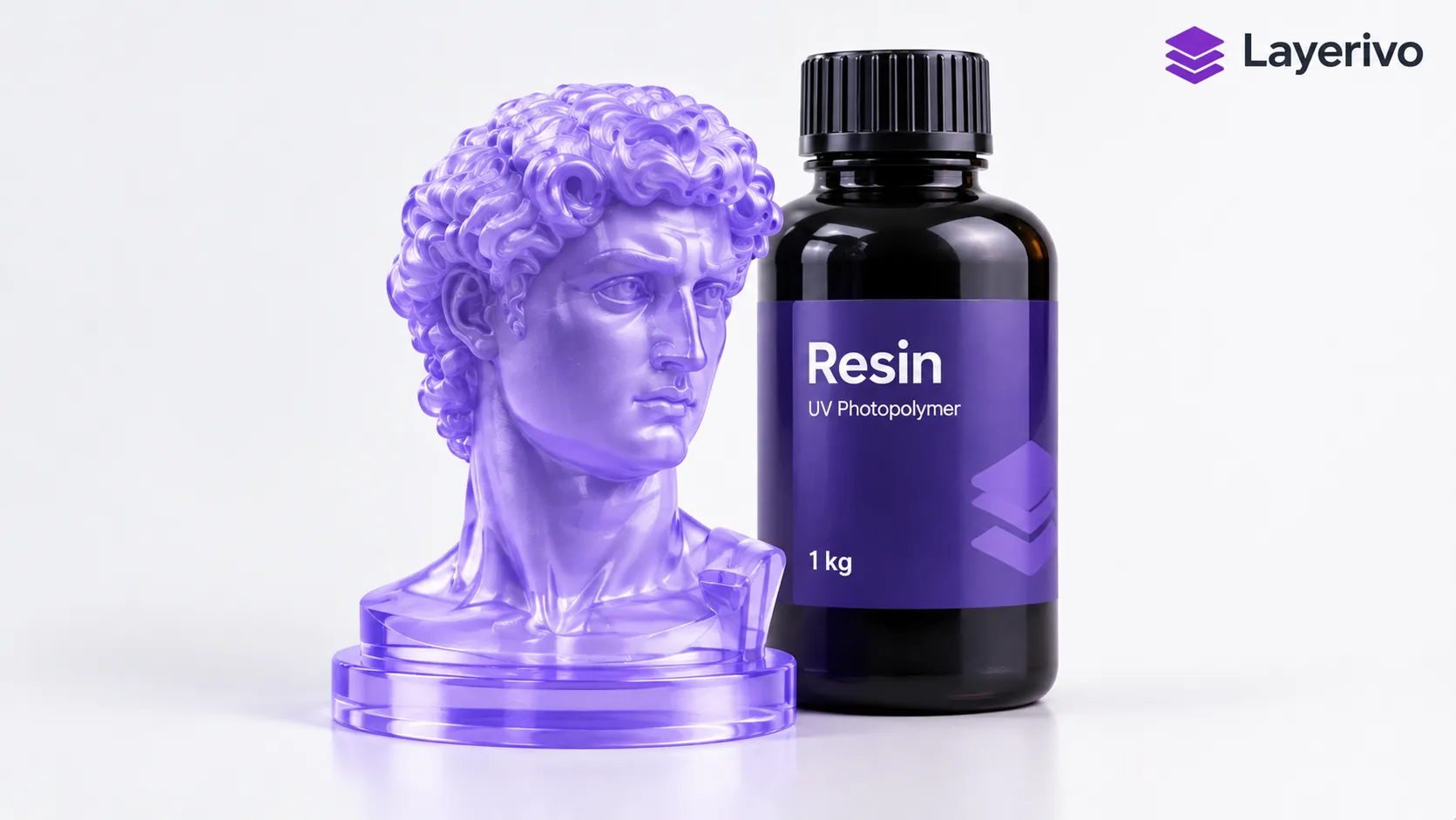
Resin-based 3D printing technologies use liquid photopolymer materials that solidify when exposed to a suitable light source.
These materials are commonly used when fine details, smooth surfaces, and high dimensional resolution are important. Different resin formulations offer different properties, including standard, tough, flexible, castable, and engineering-focused options.
Unlike thermoplastic filaments, resin materials require a compatible resin printer and the appropriate post-processing workflow.
3. Powder-Based Materials (SLS and Other Powder Processes)
Some industrial 3D printing technologies use powdered materials instead of filament or liquid resin. Selective Laser Sintering (SLS), for example, uses a laser to fuse polymer powder into solid parts.
Common powder-based materials include nylon (such as PA12 and PA11), while other powder-based manufacturing processes can work with metals and specialized materials.
These technologies are often used for functional prototypes, complex geometries, and production parts, depending on the material and manufacturing process.
Why Does Material Selection Matter?
Two parts printed in different materials can behave very differently, even if they have exactly the same design. A rigid PLA model, for example, may work well as an indoor prototype but may not be suitable for a component exposed to high temperatures or repeated impact.
Before choosing a material, consider:
- Strength and toughness: Can the part withstand the expected load, impact, or repeated use?
- Heat resistance: Will it maintain its shape in the intended operating environment?
- Flexibility: Does the application require a rigid structure or a material that can bend and stretch?
- Chemical and environmental resistance: Will the part be exposed to moisture, sunlight, chemicals, or outdoor conditions?
- Printability: Can your printer handle the material’s temperature and printing requirements?
- Cost and availability: Is the material affordable and practical for your project?
The best material is not necessarily the strongest or most expensive one. It is the material whose properties match the actual requirements of the printed part.
FDM 3D Printing Materials: Types, Properties and Uses
FDM 3D printing uses thermoplastic filaments that soften when heated and solidify as they are deposited layer by layer. Different filament materials offer different combinations of strength, flexibility, heat resistance, durability, and printability.
Some are designed for simple models and everyday printing, while others are better suited to functional components, outdoor applications, or demanding engineering projects.
For a more detailed overview of filament properties, printing temperatures, hardware requirements, and material compatibility, consult the official Prusa Filament Material Guide.
FDM Filament Materials Comparison
The following table compares some of the most commonly used FDM filaments and their typical applications.
| Material | Strength and Durability | Heat Resistance | Flexibility | Print Difficulty | Best Uses |
|---|---|---|---|---|---|
| PLA | Rigid, but can be brittle | Low | Low | Easy | Models, prototypes, decorative objects |
| PETG | Tough and durable | Moderate | Slightly flexible | Easy to Moderate | Functional parts, containers, brackets |
| ABS | Tough and impact-resistant | Good | Moderate | Moderate to Difficult | Enclosures, mechanical components |
| ASA | Durable and weather-resistant | Good | Moderate | Moderate to Difficult | Outdoor parts, automotive components |
| TPU | Flexible and impact-resistant | Formulation-dependent | Very High | Moderate to Difficult | Flexible parts, grips, seals |
| Nylon (PA) | Strong, tough, and wear-resistant | Moderate to Good | Moderate | Difficult | Gears, hinges, mechanical parts |
| Polycarbonate (PC) | Strong and impact-resistant | Very Good | Low to Moderate | Difficult | Functional and heat-resistant components |
| Polypropylene (PP) | Tough and fatigue-resistant | Moderate | Moderate | Difficult | Hinges, containers, chemical-resistant parts |
These are general material-family comparisons, not guaranteed specifications. Actual performance depends on the filament formulation, manufacturer, printer, print orientation, and settings.
If you are deciding between these two popular filaments, read our detailed PLA vs PETG comparison to understand their differences in strength, heat resistance, printability, and best uses.
1. PLA (Polylactic Acid)
PLA is one of the most widely used materials in FDM 3D printing, especially among beginners. It is known for its relatively easy printing process, low warping, and ability to produce detailed models with a clean surface finish.
Key Properties:
- Easy to print on many standard FDM printers.
- Good stiffness and dimensional accuracy.
- Available in many colors, finishes, and specialty formulations.
- Relatively low heat resistance compared with engineering thermoplastics.
- Can be brittle under certain impact or loading conditions.
Best Uses:
- Decorative models and figurines.
- Concept models and visual prototypes.
- Desk accessories and household objects.
- Educational projects and beginner prints.
Main Limitations:
PLA is not the best choice for parts exposed to high temperatures, continuous mechanical stress, or demanding outdoor conditions. Its stiffness is useful for many models, but it may crack rather than deform under impact.
If you are choosing a specific PLA spool for your printer, see our guide to the best PLA filament for 3D printing to compare filament quality, printability, and other important buying factors.
Who Should Choose PLA?
PLA is a practical starting point for beginners and anyone producing visual models, prototypes, or general-purpose indoor objects.
2. PETG (Polyethylene Terephthalate Glycol)
PETG combines relatively easy printing with good toughness and durability. It is often chosen when PLA does not provide enough impact resistance or when a printed part needs to tolerate more demanding everyday use.
Key Properties:
- Good toughness and impact resistance.
- Better heat resistance than standard PLA in many formulations.
- Good resistance to moisture and several common chemicals.
- Some flexibility compared with more rigid materials.
- Can produce stringing and surface imperfections if printing settings are not properly adjusted.
Best Uses:
- Functional brackets and holders.
- Protective covers and enclosures.
- Household components.
- Containers and parts that need a balance of toughness and printability.
Main Limitations:
PETG can produce stringing and may be more difficult to achieve clean bridges and fine details with than PLA. It can also deform under sustained loads or elevated temperatures, depending on the formulation and design.
If you are looking for a specific PETG spool, check our guide to the best PETG filament for 3D printing to learn what to look for when comparing filament quality, consistency, and printability.
Who Should Choose PETG?
PETG is a good option for users who need more durable functional parts without moving immediately to more demanding engineering materials.
3. ABS (Acrylonitrile Butadiene Styrene)
ABS is an engineering thermoplastic valued for its toughness, impact resistance, and ability to withstand higher temperatures than standard PLA. It is commonly used for functional components and durable enclosures.
Key Properties:
- Good impact resistance and toughness.
- Higher heat resistance than standard PLA.
- Can be machined and post-processed.
- Suitable for functional prototypes and mechanical components.
- More prone to warping and shrinkage during printing.
Best Uses:
- Electronic enclosures.
- Mechanical housings and fixtures.
- Functional prototypes.
- Components that need greater heat resistance than PLA can provide.
Main Limitations:
ABS can warp as it cools, making bed adhesion and temperature control important. An enclosed printer is generally recommended, and appropriate ventilation is important because printing ABS can release emissions.
If you are comparing ABS with PLA for your next project, read our detailed PLA vs ABS comparison to understand their differences in strength, heat resistance, printability, and practical applications.
Who Should Choose ABS?
ABS is suitable for users who need tougher, more heat-resistant parts and have a printer capable of handling its temperature and enclosure requirements.
4. ASA (Acrylonitrile Styrene Acrylate)
ASA is an engineering thermoplastic with properties similar to ABS, but it offers better resistance to ultraviolet (UV) exposure and outdoor weathering. This makes it useful for parts intended to remain outside.
Key Properties:
- Good UV and weather resistance.
- Good mechanical durability.
- Better outdoor suitability than standard ABS.
- Good heat resistance compared with PLA.
- Can experience warping and shrinkage during printing.
Best Uses:
- Outdoor enclosures.
- Automotive exterior components.
- Garden and equipment accessories.
- Parts exposed to sunlight and changing weather conditions.
Main Limitations:
ASA generally requires higher printing temperatures and careful temperature management. An enclosed printer is often recommended to reduce warping. Proper ventilation is also important.
If you are choosing a filament for outdoor projects, read our best filament for outdoor 3D printing guide to compare ASA and PETG in terms of UV resistance, weather durability, and practical outdoor applications.
Who Should Choose ASA?
ASA is a strong candidate for outdoor applications where sunlight and weather exposure are important considerations.
5. TPU (Thermoplastic Polyurethane)
TPU is a flexible thermoplastic elastomer used to produce rubber-like 3D printed parts. Unlike rigid materials such as PLA and ABS, TPU can bend, stretch, and absorb impacts depending on its hardness and formulation.
Key Properties:
- High flexibility and elasticity.
- Good abrasion and wear resistance.
- Good impact absorption.
- Available in different Shore hardness grades.
- Can be more difficult to feed and print than rigid filaments.
Best Uses:
- Protective cases and bumpers.
- Flexible grips and handles.
- Gaskets and seals.
- Wearable accessories.
- Flexible prototypes and vibration-damping components.
Main Limitations:
TPU printing requires careful control of filament feeding and print speed. Softer grades can be especially challenging, and moisture can affect print quality.
If you are looking for a specific TPU spool, read our guide to the best TPU filament for 3D printing to compare Shore hardness, filament quality, printability, and what to look for when choosing between 95A and 85A TPU.
Who Should Choose TPU?
TPU is the right choice when a part needs to bend, stretch, absorb impact, or provide a soft and flexible surface.
6. Nylon (Polyamide or PA)
Nylon is an engineering thermoplastic valued for its toughness, wear resistance, and mechanical performance. It is commonly used for functional components that experience friction, repeated movement, or mechanical stress.
Key Properties:
- High toughness and abrasion resistance.
- Good fatigue resistance in suitable formulations.
- Useful for moving and mechanical components.
- Some flexibility depending on the nylon type.
- Absorbs moisture from the air, which can affect printing and material performance.
Best Uses:
- Gears and mechanical parts.
- Hinges and clips.
- Bearings and wear-resistant components.
- Functional prototypes.
- Parts exposed to repeated movement.
Main Limitations:
Nylon is moisture-sensitive and generally needs to be dried before printing. It can also warp and requires careful temperature management. Different nylon families, such as PA6 and PA12, can have noticeably different properties.
Who Should Choose Nylon?
Nylon is worth considering when toughness, wear resistance, and repeated mechanical use matter more than ease of printing.
7. Polycarbonate (PC)
Polycarbonate is a strong engineering thermoplastic known for its impact resistance and ability to withstand higher temperatures than many common desktop printing materials.
Key Properties:
- High impact resistance.
- Good mechanical strength.
- High heat resistance compared with common general-purpose filaments.
- Good dimensional stability when printed under suitable conditions.
- Requires relatively high printing temperatures.
Best Uses:
- Functional mechanical components.
- Protective enclosures.
- Heat-resistant prototypes.
- Parts that need a combination of strength and impact resistance.
Main Limitations:
PC can be challenging to print because it requires high temperatures and careful control of cooling and warping. A suitable high-temperature printer and enclosure may be necessary, depending on the formulation.
Who Should Choose PC?
PC is suitable for experienced users who need stronger, more heat-resistant parts and have a printer capable of processing it reliably.
8. Polypropylene (PP)
Polypropylene is a lightweight thermoplastic known for its chemical resistance, toughness, and resistance to repeated bending. It is particularly useful for applications involving flexible hinges and containers.
Key Properties:
- Low density and lightweight parts.
- Good chemical resistance.
- Good fatigue resistance under repeated bending.
- Some flexibility compared with rigid engineering plastics.
- Difficult bed adhesion on many common printing surfaces.
Best Uses:
- Living hinges and flexible joints.
- Chemical-resistant containers.
- Lightweight functional components.
- Parts that need repeated bending.
Main Limitations:
PP can be difficult to print because it has poor adhesion to many standard build surfaces and may warp. It often requires a compatible build surface and carefully tuned printing settings.
Who Should Choose PP?
PP is useful when chemical resistance, low weight, and repeated bending are important, provided your printer and build surface can handle the material.
Quick Summary: Which FDM Material Should You Choose?
- For beginners: PLA.
- For everyday functional parts: PETG.
- For durable enclosures: ABS.
- For outdoor applications: ASA.
- For flexible and rubber-like parts: TPU.
- For gears and wear-resistant components: Nylon.
- For higher heat and impact resistance: Polycarbonate.
- For living hinges and chemical-resistant parts: Polypropylene.
The best choice depends on the actual requirements of the part, not simply which material has the highest strength rating. Printer compatibility, printing conditions, and the intended environment all matter.
Resin 3D Printing Materials: Types, Properties and Uses
Resin 3D printing uses liquid photopolymer materials that harden when exposed to a suitable light source. Unlike FDM printing, which deposits melted filament, resin technologies such as SLA, DLP, and MSLA solidify liquid resin layer by layer.
Resin materials are particularly useful when fine details, smooth surface finishes, and accurate small features are important. However, different resin formulations offer different mechanical properties, ranging from rigid and brittle materials to flexible, impact-resistant, and specialized engineering resins.
For examples of how different resin formulations are matched to specific applications, explore Formlabs’ guide to choosing the right resin, which covers standard, tough, durable, flexible, and high-temperature resin options.
Resin 3D Printing Materials Comparison
The following table summarizes common resin categories and their typical applications.
| Resin Type | Main Properties | Best Uses | Main Limitation |
|---|---|---|---|
| Standard Resin | High detail, smooth finish, relatively rigid | Miniatures, models, visual prototypes | Can be brittle |
| ABS-Like / Tough Resin | Improved toughness and impact resistance | Functional prototypes, brackets, enclosures | Properties vary between formulations |
| Water-Washable Resin | Designed for water-based cleaning | Models and general-purpose prints | Still requires safe handling and proper curing |
| Flexible Resin | Bends and deforms more easily | Grips, flexible prototypes, soft components | Can be difficult to print and post-process |
| High-Temperature Resin | Designed to retain properties under elevated temperatures | Heat-exposed fixtures, molds, prototypes | Often requires specialized printing and curing conditions |
| Castable Resin | Designed to burn out during investment casting | Jewelry and precision casting patterns | Requires a compatible casting workflow |
| Dental and Biocompatible Resin | Formulated for specific medical or dental applications | Dental models, surgical guides, and approved devices | Requires validated materials and application-specific certification |
These are general resin categories. Actual performance, compatibility, and post-processing requirements depend on the manufacturer and specific formulation.
1. Standard Resin
Standard resin is one of the most common materials used in desktop resin 3D printing. It is designed to produce detailed models with smooth surfaces and fine features, making it a popular choice for visual applications.
Key Properties:
- High detail reproduction.
- Smooth surface finish.
- Good dimensional accuracy when properly calibrated.
- Available in different colors and transparency levels.
- Often relatively brittle compared with tough or engineering resins.
Best Uses:
- Miniatures and figurines.
- Decorative models.
- Product design prototypes.
- Detailed visual components.
- Small models that prioritize appearance over mechanical performance.
Main Limitations:
Standard resin can crack or break under impact, especially in thin sections. It is generally not the first choice for components that experience repeated bending or significant mechanical loads.
Who Should Choose Standard Resin?
Standard resin is a good starting point for users who prioritize fine details and surface quality rather than flexibility or high impact resistance.
2. ABS-Like and Tough Resin
ABS-like and tough resins are designed to produce parts with improved toughness compared with many standard resin formulations. They are commonly used when printed components need to withstand handling, impact, or moderate mechanical stress.
Key Properties:
- Improved impact resistance in suitable formulations.
- Better resistance to cracking than many standard resins.
- Suitable for functional prototypes.
- Mechanical properties vary significantly between products.
Best Uses:
- Product housings and enclosures.
- Functional prototypes.
- Clips and small mechanical components.
- Parts that need more durability than standard resin provides.
Main Limitations:
ABS-like does not mean that the resin has exactly the same properties as injection-molded ABS plastic. Different manufacturers use different formulations, so strength, flexibility, and heat resistance should be checked in the technical data sheet.
Who Should Choose Tough Resin?
Choose this category when a printed part needs to handle more impact or mechanical stress than a typical display model, but verify the material’s actual specifications before using it in a demanding application.
3. Water-Washable Resin
Water-washable resin is formulated to allow printed parts to be cleaned with water rather than requiring isopropyl alcohol (IPA) as the primary washing liquid.
It can simplify part of the cleaning process, particularly for hobbyists who prefer a water-based washing workflow.
Key Properties:
- Designed for water-based cleaning.
- Available in different colors and formulations.
- Can produce detailed models.
- Mechanical properties depend on the specific resin formulation.
Best Uses:
- Miniatures and decorative models.
- General-purpose hobby printing.
- Projects where water-based cleaning is preferred.
Main Limitations:
Water-washable resin is not harmless or safe to dispose of directly down the drain. Uncured resin and contaminated washing water still require appropriate handling and disposal. Printed parts also need the manufacturer’s recommended post-curing process.
Water-washable describes the cleaning method, not a guarantee of greater strength, safety, or environmental friendliness.
Who Should Choose Water-Washable Resin?
It may suit hobbyists who prefer a water-based cleaning workflow, provided they are prepared to handle contaminated water and uncured resin responsibly.
4. Flexible Resin
Flexible resin is designed to produce parts that can bend, compress, or deform more easily than rigid standard resins. Depending on the formulation, some products can simulate rubber-like behavior.
Key Properties:
- Greater flexibility than standard rigid resin.
- Can absorb deformation and compression.
- Available in different hardness levels.
- Some formulations offer elastic recovery after bending.
Best Uses:
- Flexible prototypes.
- Grips and soft-touch components.
- Gaskets and seals.
- Wearable product concepts.
- Soft inserts and cushioning components.
Main Limitations:
Flexible resins can be more difficult to print and post-process than standard formulations. Their flexibility, tear resistance, and recovery behavior vary considerably, so the manufacturer’s technical data should guide material selection.
Who Should Choose Flexible Resin?
Choose flexible resin when a part needs to bend or compress rather than remain completely rigid.
5. High-Temperature and Engineering Resin
Engineering resins are specialized photopolymers developed for applications that require particular mechanical, thermal, electrical, or chemical properties.
High-temperature resin is one example. It is designed for applications where printed parts must maintain their shape under elevated temperatures.
Key Properties:
- Formulations designed for specific engineering requirements.
- Some offer higher heat-deflection temperatures than standard resins.
- Other engineering formulations prioritize rigidity, toughness, or electrical properties.
- Often require carefully controlled post-processing.
Best Uses:
- Heat-resistant prototypes and fixtures.
- Mold and tooling prototypes.
- Engineering components.
- Specialized testing and product development.
Main Limitations:
Engineering resin is not one universal material category with identical properties. A high-temperature resin, a rigid resin, and an electrically dissipative resin serve different purposes. Some require specialized printers, validated settings, or particular curing equipment.
Who Should Choose Engineering Resin?
Choose an engineering formulation only after identifying the exact performance requirement, such as heat resistance, stiffness, impact strength, or electrical behavior.
6. Castable Resin
Castable resin is designed for patterns used in investment casting. The printed model is incorporated into a casting mold and removed through a controlled burnout process, leaving a cavity that can be filled with molten metal.
This makes castable resin especially useful in jewelry production and other applications requiring detailed casting patterns.
Key Properties:
- Designed for investment-casting workflows.
- Can reproduce fine details and small features.
- Formulated for controlled burnout.
- Available in different casting-specific formulations.
Best Uses:
- Jewelry patterns.
- Rings and detailed ornaments.
- Small precision-casting components.
- Custom design and manufacturing workflows.
Main Limitations:
Castable resin is not intended to function as a normal finished plastic component. It must be compatible with the casting material, investment process, and burnout schedule. Incorrect processing can lead to residue or casting defects.
Who Should Choose Castable Resin?
It is suitable for jewelers, designers, and manufacturers who use resin printing to create patterns for investment casting.
7. Dental and Biocompatible Resin
Dental and biocompatible resins are specialized materials developed for specific medical or dental applications. Depending on their formulation and regulatory status, they may be used to produce dental models, surgical guides, splints, or other approved devices.
Key Properties:
- Designed for defined medical or dental applications.
- Some formulations have documented biocompatibility testing.
- May provide specific mechanical, dimensional, or aesthetic properties.
- Require application-specific processing and post-curing.
Best Uses:
- Dental models.
- Surgical guides.
- Dental splints and retainers.
- Other manufacturer-approved medical or dental applications.
Main Limitations:
Not every resin labeled as dental or biocompatible is suitable for every medical application. Biocompatibility depends on the exact material, intended use, processing conditions, and relevant regulatory requirements.
Who Should Choose Dental or Biocompatible Resin?
These materials are intended for qualified dental, medical, and professional workflows. Always verify the manufacturer’s documentation and the specific approved application before use.
Quick Summary: Which Resin Should You Choose?
- For miniatures and detailed models: Standard Resin.
- For tougher functional prototypes: ABS-Like or Tough Resin.
- For water-based cleaning: Water-Washable Resin.
- For flexible components: Flexible Resin.
- For heat-resistant applications: High-Temperature Resin.
- For jewelry casting: Castable Resin.
- For professional dental applications: The appropriate certified Dental or Biocompatible Resin.
The most important factor is matching the resin formulation to the intended application. A material that produces excellent detail may not provide the toughness or heat resistance needed for a functional component.
Advanced and Specialty 3D Printing Materials
Beyond standard filaments and resins, 3D printing also supports advanced materials designed for demanding engineering and industrial applications. These materials can offer improved stiffness, strength, wear resistance, chemical resistance, or high-temperature performance.
Some are reinforced composites based on common thermoplastics, while others are high-performance polymers that require specialized industrial printing equipment.
Understanding the difference is important: a fiber-reinforced PLA filament, for example, does not have the same performance or printing requirements as a carbon-fiber-reinforced PEEK material.
For a deeper look at fiber reinforcement in additive manufacturing, explore this scientific review of fiber selection for reinforced 3D printing, which examines carbon, glass, and other reinforcing fibers used in polymer-based materials.
Advanced 3D Printing Materials Comparison
| Material | Main Characteristics | Common Applications | Printing Requirements |
|---|---|---|---|
| PLA-CF | Increased stiffness and dimensional stability compared with many standard PLA formulations | Rigid prototypes, fixtures, lightweight components | Abrasion-resistant nozzle recommended |
| PETG-CF | Stiffness and dimensional stability with the properties of a PETG base | Functional prototypes, brackets, equipment components | Hardened nozzle recommended |
| PA-CF | Stiffness, strength, and reduced warping compared with some unfilled nylon formulations | Mechanical parts, jigs, fixtures, lightweight structures | Hardened nozzle, filament drying, suitable high-temperature printer |
| PA-GF | Glass-fiber reinforcement with improved stiffness and dimensional stability | Industrial components, structural parts, mechanical fixtures | Abrasion-resistant nozzle and suitable printer |
| PC-CF | High stiffness and dimensional stability combined with a polycarbonate base | Engineering prototypes and demanding functional components | High-temperature printer and hardened nozzle |
| PEEK | High-performance thermoplastic with excellent thermal and chemical resistance | Aerospace, industrial, and specialized engineering parts | Specialized high-temperature industrial printer |
| PEI (Ultem) | High heat resistance, mechanical stability, and flame-retardant formulations | Aerospace interiors and industrial components | Industrial printer with high-temperature capabilities |
These are general material-family descriptions. Actual properties depend on the polymer grade, fiber content, manufacturing process, and printing conditions.
1. Carbon Fiber-Reinforced Filaments (CF)
Carbon fiber-reinforced filaments combine a thermoplastic base material with short carbon fibers. The base polymer may be PLA, PETG, nylon, polycarbonate, or another thermoplastic.
The carbon fibers can improve stiffness, dimensional stability, and weight efficiency. However, the final performance still depends heavily on the underlying polymer.
Key Properties:
- Increased stiffness compared with many unfilled versions of the same base polymer.
- Improved dimensional stability in suitable formulations.
- Lightweight composite construction.
- Often a matte surface finish with less visible layer lines.
- Abrasive fibers that can wear standard brass nozzles.
Best Uses:
- Lightweight structural prototypes.
- Mechanical fixtures and jigs.
- RC components and drone frames.
- Rigid brackets and equipment parts.
- Functional components where stiffness and dimensional stability are important.
Main Limitations:
Carbon-fiber-filled filament is not automatically stronger in every direction or more impact-resistant than its unfilled equivalent. Fiber reinforcement can reduce impact resistance and layer-to-layer adhesion in some formulations.
The fibers are also abrasive, so a hardened steel or another abrasion-resistant nozzle is recommended. Printing requirements depend on the base polymer: PLA-CF, PETG-CF, and PA-CF should not be treated as interchangeable materials.
Who Should Choose Carbon Fiber Filament?
Choose a carbon-fiber-filled filament when you need a stiffer, dimensionally stable, or lightweight part and have a printer equipped to handle abrasive materials.
2. Glass Fiber-Reinforced Filaments (GF)
Glass fiber-reinforced filaments combine a thermoplastic polymer with short glass fibers. They are used to modify the stiffness, dimensional stability, and mechanical behavior of the base material.
Like carbon-fiber composites, glass-fiber filaments are available with different polymer bases, including PETG, nylon, and other engineering thermoplastics.
Key Properties:
- Increased stiffness in many formulations.
- Improved dimensional stability.
- Reduced warping in some material combinations.
- Suitable for functional and industrial components.
- Abrasive fibers that can wear standard nozzles.
Best Uses:
- Industrial mechanical parts.
- Structural frames and brackets.
- Equipment fixtures.
- Functional prototypes.
- Components requiring dimensional stability.
Main Limitations:
Glass-fiber reinforcement does not guarantee better performance in every mechanical property. The base polymer and fiber concentration determine the final behavior.
As with carbon-fiber-filled materials, an abrasion-resistant nozzle is generally recommended. The required printing temperature and enclosure depend on the polymer used as the base material.
Who Should Choose Glass Fiber Filament?
Glass-fiber composites are worth considering when stiffness and dimensional stability are important, particularly for functional components and industrial prototypes.
3. Carbon Fiber vs. Glass Fiber Filaments
Both materials are composite filaments, but they are not identical.
| Comparison | Carbon Fiber (CF) | Glass Fiber (GF) |
|---|---|---|
| Reinforcement | Short carbon fibers | Short glass fibers |
| Main advantage | High stiffness and lightweight performance in suitable formulations | Improved stiffness and dimensional stability in suitable formulations |
| Appearance | Often dark or matte | Depends on the base polymer and fiber formulation |
| Nozzle wear | Abrasive | Abrasive |
| Typical applications | Lightweight structural parts and rigid prototypes | Industrial fixtures, frames, and functional components |
Neither material is universally better. Compare the specific filament’s technical data sheet rather than choosing based on the fiber name alone.
4. PEEK (Polyether Ether Ketone)
PEEK is a high-performance thermoplastic used in demanding engineering applications. It is known for its combination of mechanical strength, thermal stability, and chemical resistance.
Unlike common desktop filaments such as PLA and PETG, PEEK requires specialized printing conditions and is generally processed using industrial high-temperature FDM systems.
Key Properties:
- High mechanical performance.
- Excellent thermal resistance.
- Strong chemical resistance.
- Good wear resistance in suitable grades.
- Suitable for demanding industrial applications.
Best Uses:
- Aerospace components.
- Industrial mechanical parts.
- Specialized engineering prototypes.
- Components exposed to elevated temperatures.
- Applications requiring chemical resistance.
Main Limitations:
PEEK is expensive and difficult to process. It requires a printer capable of maintaining very high extrusion and chamber temperatures, along with carefully controlled printing conditions.
It is not a practical material for most standard desktop 3D printers.
Who Should Choose PEEK?
PEEK is intended for industrial users and engineers who need a high-performance polymer and have access to compatible manufacturing equipment.
5. PEI (Polyetherimide / Ultem)
PEI is another high-performance thermoplastic used in demanding industrial and aerospace applications. Ultem is a well-known trade name associated with PEI materials.
Certain PEI grades offer high heat resistance, mechanical stability, and flame-retardant properties, making them suitable for applications where ordinary thermoplastics may not meet performance requirements.
Key Properties:
- High thermal stability.
- Good mechanical strength.
- Chemical resistance in suitable grades.
- Flame-retardant properties in specific formulations.
- Available in grades developed for specialized industrial applications.
Best Uses:
- Aerospace interior components.
- Industrial fixtures and functional parts.
- Electrical and electronic components.
- Applications requiring specific flame, smoke, and toxicity performance.
Main Limitations:
PEI requires specialized high-temperature printing equipment and controlled processing conditions. Its properties also vary between grades, so a material’s certification or performance should never be assumed from the PEI name alone.
Who Should Choose PEI?
PEI is appropriate for professional and industrial applications that require its specific thermal, mechanical, or flame-related properties.
6. Other High-Performance Polymers
PEEK and PEI are not the only materials used in advanced 3D printing. Other high-performance polymers include:
- PEKK (Polyetherketoneketone): A high-performance polymer related to PEEK, used in demanding engineering and aerospace applications.
- PPSU (Polyphenylsulfone): Known for high-temperature performance and resistance to certain chemicals and repeated sterilization processes.
- PPS (Polyphenylene Sulfide): Offers chemical and thermal resistance in suitable grades.
- PEKK and reinforced polymer blends: Used in specialized applications where specific mechanical, thermal, or processing properties are required.
These materials generally require specialized equipment and carefully controlled printing conditions. Their suitability depends on the exact grade and application.
Important: Do You Need a Special 3D Printer?
Advanced materials often require more than simply changing the filament spool.
Before purchasing a fiber-reinforced or high-performance polymer, check whether your printer supports:
- Abrasion-resistant nozzles: Needed for carbon- and glass-fiber-filled filaments.
- High extrusion temperatures: Required by materials such as nylon, PC, PEEK, and PEI.
- A heated enclosure or chamber: Important for controlling shrinkage and warping in many engineering polymers.
- Filament drying: Essential for moisture-sensitive materials, particularly nylon and several high-performance polymers.
- Compatible build surfaces: Different polymers require different adhesion and surface-preparation methods.
Always check the printer manufacturer’s supported-material list and the filament supplier’s technical data sheet before printing.
Advanced materials can expand what 3D printing is capable of producing, but their benefits only matter when the material, printer, and intended application are properly matched.
Comparing 3D Printing Materials by Performance
Choosing a 3D printing material becomes easier when you compare its performance against the requirements of your project. However, properties such as strength, toughness, stiffness, flexibility, and heat resistance are not interchangeable.
For example, a material can have high tensile strength but still crack under impact. Another material may be less rigid but absorb repeated deformation without breaking.
The following comparisons explain how common 3D printing materials perform across different requirements.
1. Which 3D Printing Material Is the Strongest?
There is no single strongest 3D printing material for every application. Tensile strength measures how much pulling force a material can withstand before breaking, while impact strength measures its ability to absorb sudden force.
Stiffness is another separate property: a stiff material resists bending, but that does not necessarily mean it is tougher or more impact-resistant.
For common FDM materials:
- Nylon (PA): Offers a useful combination of toughness, wear resistance, and mechanical performance, making it suitable for moving parts and functional components.
- Polycarbonate (PC): Provides high impact resistance and good mechanical strength, making it useful for demanding functional parts.
- ABS: Offers good impact resistance and toughness, particularly for enclosures and durable components.
- PETG: Provides a practical balance of toughness, durability, and printability.
- PLA: Can have relatively high tensile strength and stiffness, but many standard formulations are more brittle than ABS or nylon.
- Carbon Fiber-Reinforced Filaments: Can offer high stiffness and dimensional stability, but their impact resistance and layer adhesion depend on the base polymer and formulation.
For resin printing, tough and engineering resins may provide better impact resistance or mechanical performance than standard resin. However, their properties vary significantly between products.
Key Takeaway: Choose a material based on the type of strength your part needs. For impact resistance, look at toughness and impact data. For a rigid structure, consider stiffness. For a load-bearing component, check tensile and flexural properties.
2. Which 3D Printing Materials Have the Best Heat Resistance?
Heat resistance matters when a printed part will be exposed to warm environments, engines, electronic equipment, or industrial processes.
Among common desktop FDM materials, their typical heat-resistance characteristics can be summarized as follows:
| Material | General Heat-Resistance Level | Typical Applications |
|---|---|---|
| PLA | Low | Indoor models and prototypes |
| PETG | Moderate | General functional parts |
| ABS | Good | Enclosures and mechanical components |
| ASA | Good | Outdoor and automotive components |
| Nylon (PA) | Formulation-dependent | Mechanical and engineering parts |
| Polycarbonate (PC) | Very Good | Heat-exposed functional components |
| PEEK | Very High | Specialized industrial applications |
| PEI (Ultem) | Very High | Aerospace and industrial components |
For a more detailed comparison of high-temperature filaments, including PC, ASA, ABS, Nylon, and PEEK, read our guide to the best heat-resistant 3D printer filament.
Heat-deflection temperature (HDT) is one useful measurement for comparing materials. It indicates the temperature at which a test specimen deforms by a specified amount under a defined load.
However, HDT is not the same as a safe continuous operating temperature. The test load, material grade, print orientation, and part design all affect real-world performance.
Key Takeaway: PLA is generally unsuitable for parts exposed to sustained high temperatures. For more demanding applications, ABS, ASA, PC, or specialized engineering polymers may be more appropriate, depending on the required temperature and mechanical load.
3. Which Materials Are the Most Flexible?
Flexibility describes how much a material can deform without breaking. It is especially important for parts that need to bend, stretch, compress, or absorb vibration.
| Material | General Flexibility | Common Applications |
|---|---|---|
| PLA | Low | Rigid models and prototypes |
| PETG | Low to Moderate | Functional parts with some toughness |
| ABS | Moderate | Durable enclosures and components |
| Nylon (PA) | Moderate to High, depending on grade | Hinges, clips, and mechanical parts |
| TPU | Very High | Flexible cases, seals, grips, and bumpers |
| Flexible Resin | Formulation-dependent | Soft prototypes and flexible components |
TPU is one of the most common choices for flexible FDM printing. It is available in different Shore hardness grades, allowing users to select a softer or firmer material depending on the application.
Flexible resin is another option for resin printers, but its flexibility, tear resistance, and elastic recovery depend on the specific formulation.
Key Takeaway: Choose TPU for flexible filament-based parts and a compatible flexible resin when using a resin printer. Always check the hardness and deformation properties rather than relying on the word “flexible” alone.
4. Which Materials Are Best for Outdoor Use?
Outdoor parts must deal with more than mechanical loads. Sunlight, ultraviolet (UV) exposure, moisture, temperature changes, and environmental conditions can all affect material performance.
| Material | Outdoor Suitability | Main Consideration |
|---|---|---|
| PLA | Limited | Can soften in heat and degrade under prolonged outdoor exposure |
| PETG | Moderate | Good moisture resistance, but UV performance varies |
| ABS | Limited to Moderate | Can degrade with prolonged UV exposure |
| ASA | Very Good | Designed for better UV and weather resistance |
| Nylon (PA) | Application-dependent | Moisture absorption can affect dimensions and properties |
| PC | Application-dependent | UV stability depends on formulation and protection |
ASA is often a strong choice for outdoor FDM parts because it offers better UV and weather resistance than standard ABS.
PETG can also work for many outdoor applications, but its long-term performance depends on the grade and exposure conditions.
Key Takeaway: For parts exposed to direct sunlight and changing weather, ASA is often a better starting point than standard PLA or ABS. Check the manufacturer’s outdoor-use and UV-resistance data before selecting a material.
5. Which Materials Are Best for Functional and Mechanical Parts?
Functional parts need to perform reliably under the conditions they were designed for. Depending on the application, this may involve impact resistance, repeated movement, friction, heat, chemical exposure, or dimensional stability.
Consider these common choices:
- PETG: Useful for brackets, holders, covers, and general functional components.
- ABS: Suitable for durable enclosures and parts requiring good impact resistance.
- Nylon (PA): Useful for gears, hinges, clips, and wear-resistant components.
- Polycarbonate (PC): Worth considering for parts requiring high impact resistance and heat performance.
- Carbon Fiber-Reinforced Nylon: Useful for stiff, lightweight fixtures and structural prototypes.
- Engineering Resins: Suitable for specialized prototypes when their documented mechanical properties match the application.
The best option depends on the actual forces and environmental conditions the part will experience. A gear, for example, may need wear resistance and fatigue performance, while an enclosure may prioritize impact resistance and dimensional stability.
6. Which Materials Are Easiest to Print?
Material performance is only useful if your printer can process the material reliably. Print difficulty affects the time, equipment, and experience required to achieve consistent results.
| Material | General Print Difficulty | Main Challenge |
|---|---|---|
| PLA | Easy | Relatively limited heat resistance |
| PETG | Easy to Moderate | Stringing and surface quality |
| TPU | Moderate to Difficult | Flexible filament feeding |
| ABS | Moderate to Difficult | Warping and shrinkage |
| ASA | Moderate to Difficult | Temperature control and warping |
| Nylon (PA) | Difficult | Moisture absorption and warping |
| Polycarbonate (PC) | Difficult | High printing temperatures and enclosure requirements |
| PEEK / PEI | Very Difficult | Specialized high-temperature equipment |
For resin printing, standard resin is often a practical starting point, while flexible, castable, and engineering resins may require more specific settings and post-processing procedures.
Key Takeaway: PLA is generally the easiest starting material for FDM beginners. If you need more demanding properties, make sure your printer supports the required temperatures, nozzle type, enclosure, and material-handling conditions.
Quick Material Selection Guide
Use this table to narrow down your options based on the main requirement of your project.
| If Your Priority Is… | Materials to Consider |
|---|---|
| Easy printing | PLA |
| General-purpose functional parts | PETG |
| Impact resistance | ABS, PC, or suitable tough resin |
| High stiffness | Carbon Fiber-Reinforced Filament |
| Flexibility | TPU or Flexible Resin |
| Outdoor durability | ASA |
| Wear resistance | Nylon (PA) |
| Higher heat resistance | PC, PEEK, or PEI |
| Fine details and smooth surfaces | Standard Resin |
| Jewelry casting | Castable Resin |
These recommendations are starting points rather than universal rankings. Always compare the technical data sheet of the exact material you intend to use and confirm that your printer supports it.
Important: Why Printed Parts May Not Match Material Datasheets
Material properties are often measured using standardized test specimens, but a 3D printed part does not always behave like a molded plastic sample.
FDM parts are built in layers, which can create directional differences in mechanical performance. A part may withstand more force when loaded along the printed layers than when force is applied across the layer interfaces.
Other factors also influence the final result:
- Print orientation and layer direction.
- Nozzle temperature and layer adhesion.
- Infill density and internal structure.
- Wall count and part geometry.
- Moisture content and material storage.
- Post-processing and annealing, where applicable.
For this reason, a material’s published tensile strength or heat-deflection temperature should not be treated as a guaranteed performance value for every printed object.
For demanding applications, test the actual printed design under representative conditions before relying on it in service.
How to Choose the Right 3D Printing Material
Choosing the right 3D printing material starts with understanding what the printed part needs to do. A material that works well for a decorative model may not be suitable for a mechanical component, an outdoor enclosure, or a flexible product.
If you are new to FDM printing and still deciding which material to buy first, read our guide to the best 3D printer filament for beginners for practical recommendations on PLA, PETG, and other beginner-friendly options.
Instead of choosing based on popularity alone, consider the part’s function, operating environment, required mechanical properties, and your printer’s capabilities.
1. Choose a Material Based on Your Project
The following examples connect common project requirements with suitable material options.
| Project or Application | Materials to Consider | Why They May Be Suitable |
|---|---|---|
| Decorative models and figurines | PLA or Standard Resin | Easy preparation, good appearance, and detailed results |
| Functional household parts | PETG or ABS | Useful balance of toughness and durability |
| Outdoor components | ASA or suitable PETG | Better options for environmental exposure than standard PLA |
| Flexible products and accessories | TPU or Flexible Resin | Designed to bend or deform |
| Mechanical gears and moving parts | Nylon (PA) | Toughness and wear resistance |
| High-impact components | PC or suitable Tough Resin | Designed for improved impact performance |
| Lightweight, rigid fixtures | Carbon Fiber-Reinforced Filament | Increased stiffness in suitable formulations |
| Detailed miniatures | Standard Resin | Fine details and smooth surface finish |
| Jewelry casting patterns | Castable Resin | Designed for investment-casting workflows |
| High-temperature engineering components | PEEK, PEI, or suitable High-Temperature Resin | Specialized formulations for elevated-temperature applications |
These are starting recommendations, not guaranteed solutions. The exact material grade, printer, part geometry, and operating conditions all affect the final result.
2. Consider the Printing Technology You Have
Not every material works with every 3D printer. Before purchasing a filament or resin, identify the printing technology your machine uses.
If You Have an FDM Printer:
You will generally use thermoplastic filaments such as PLA, PETG, ABS, ASA, TPU, nylon, and polycarbonate.
Check:
- Maximum nozzle and bed temperatures.
- Whether the printer has an enclosed build chamber.
- Whether the extruder can handle flexible filament.
- Whether an abrasion-resistant nozzle is needed.
- Whether the filament requires drying.
If You Have a Resin Printer:
You will use a compatible photopolymer resin, such as standard, tough, flexible, castable, or engineering resin.
Check:
- Whether the resin is compatible with your printer’s wavelength and technology.
- Whether the manufacturer provides suitable exposure settings.
- Whether your washing and curing equipment supports the material.
- Whether the resin requires specialized post-processing.
A resin designed for one application should not automatically be assumed to work with every resin printer or post-processing workflow.
3. Balance Performance Against Printing Difficulty
A material with better mechanical properties may require more demanding printing conditions. This can increase preparation time, equipment requirements, and the likelihood of failed prints.
For example:
- PLA is a practical choice when ease of printing matters more than heat resistance.
- PETG can provide more toughness for functional parts without requiring the same printing conditions as many engineering polymers.
- Nylon may be suitable for mechanical components, but moisture control and printer capability become more important.
- PEEK offers specialized engineering properties, but requires industrial high-temperature printing equipment.
Consider whether the additional performance is genuinely necessary. For many projects, a well-designed part made from an easier material is more practical than using an advanced material without a clear need.
4. Consider the Total Cost, Not Just the Material Price
The price of a filament spool or resin bottle is only one part of the total cost of a printed component.
Other factors may include:
- Material waste and failed prints.
- Support structures and post-processing.
- Electricity and equipment requirements.
- Drying and storage equipment.
- Replacement nozzles and printer maintenance.
- Washing, curing, and protective equipment for resin printing.
For example, a low-cost filament may be more economical for simple prototypes, while an engineering material may justify its higher cost when the application requires specific performance.
5. Check Material Safety and Handling Requirements
Different 3D printing materials require different handling precautions.
For FDM printing, follow the filament manufacturer’s guidance for ventilation, temperature, and storage. Some materials, including ABS and other engineering polymers, can release emissions during printing.
For resin printing, uncured photopolymer resin requires careful handling. Use appropriate protective equipment, follow the manufacturer’s safety data sheet (SDS), and handle contaminated washing liquids and waste responsibly.
Do not assume that a material is safe for food contact, skin contact, or medical use simply because it is described as non-toxic, biodegradable, or biocompatible. Verify the relevant certification and intended application.
6. Check the Manufacturer’s Technical Data Sheet
Before choosing a material for a demanding application, review its technical data sheet (TDS) and safety data sheet (SDS).
The TDS can help you compare:
- Tensile strength and elongation at break.
- Flexural strength and modulus.
- Impact resistance.
- Heat-deflection temperature (HDT).
- Recommended printing temperatures.
- Moisture sensitivity and post-processing requirements.
The SDS provides information about handling, storage, hazards, and safety precautions.
Whenever possible, compare data from the same manufacturer and testing method. Values from different suppliers may not be directly comparable.
Final Material Selection Checklist
Before buying a material, ask yourself:
- Does it provide the mechanical properties my part needs?
- Will it withstand the expected temperature and environment?
- Is it compatible with my printer?
- Can I meet its printing and post-processing requirements?
- Is the total cost reasonable for this project?
- Have I checked the manufacturer’s technical and safety documentation?
The right material is the one that meets the actual requirements of your project while remaining practical to print, process, and use.
Frequently Asked Questions About 3D Printing Materials
1. Can You Use Different Filament Materials in the Same 3D Printer?
Yes, many FDM printers can use different filament materials, provided the printer supports their required temperatures, feeding characteristics, and other printing conditions.
For example, a printer that handles PLA may also support PETG or TPU. However, materials such as nylon, polycarbonate, and carbon-fiber-filled filaments may require higher temperatures, an enclosed chamber, or an abrasion-resistant nozzle.
Always check your printer’s supported-material list before switching filaments.
2. Do Carbon Fiber Filaments Require a Special Nozzle?
Carbon-fiber-filled filaments are abrasive and can wear standard brass nozzles over time. Using a hardened steel nozzle or another abrasion-resistant option is generally recommended.
The required nozzle size and temperature depend on the filament manufacturer and the base polymer. Check the material’s printing recommendations before use.
3. Can You Use Any Resin in a Resin 3D Printer?
No. Resin compatibility depends on the printer’s light source, wavelength, technology, and manufacturer requirements.
Even if two printers use a similar LCD-based process, their recommended resin profiles and exposure settings may differ. Check the printer manufacturer’s compatibility guidance and the resin supplier’s technical documentation before printing.
4. How Should You Store 3D Printing Filament?
Filament should generally be stored in a cool, dry environment and protected from moisture and dust. Some materials, particularly nylon and other moisture-sensitive engineering filaments, can absorb water from the air and may need drying before printing.
A sealed storage container or suitable filament storage system with desiccant can help protect material quality. Follow the manufacturer’s recommendations for drying temperature and storage conditions.
5. Are 3D Printed Parts Food Safe?
Not automatically. Food-contact safety depends on the material formulation, additives, printing process, surface finish, equipment, and intended use.
Even a filament marketed as food-safe does not guarantee that the finished printed object is suitable for direct food contact. Layer lines can also create surfaces that are difficult to clean thoroughly.
For food-contact applications, verify the relevant certifications and manufacturer documentation for the complete material and manufacturing process. Do not assume that PLA, PETG, or another common filament is automatically food-safe.
Final Verdict: Choosing the Best 3D Printing Material
There is no single best 3D printing material for every project. The right choice depends on the part’s intended use, required mechanical properties, operating environment, budget, and the capabilities of your printer.
For most beginners, PLA is a practical starting point because it is easy to print and works well for models and prototypes. PETG is a useful next step for functional parts that need greater toughness, while ABS and ASA are worth considering for more demanding applications and outdoor use.
For flexible components, TPU is a common choice. Nylon and carbon-fiber-reinforced filaments offer options for mechanical parts and lightweight, rigid components, while PC, PEEK, and PEI serve more demanding engineering applications when the printer can handle them.
Resin materials are a better fit when fine details and smooth surface finishes are priorities. Standard, tough, flexible, castable, and engineering resins serve different purposes, so the exact formulation matters.
Before buying any material, check its technical data sheet, confirm printer compatibility, and consider the complete printing and post-processing requirements.
Ultimately, the best material is not necessarily the strongest or most expensive one. It is the material that meets your project’s requirements while remaining practical to print and use.
Leave a Reply